

Alocasia Guide: Rare Tropical Plants - Cultivation and Substrate
🌿✨ Alocasias
The complete guide to rare tropical plants, from morphology to successful cultivation in Europe
🌱 Introduction
There's a moment every plant enthusiast knows. You stumble upon an Alocasia and, without understanding why, you find yourself captivated by its leaves. They have this almost unreal quality. A presence. A graphic tension. A prehistoric yet elegant quality. And then, your plant-addict brain starts working overtime.
You think it's just a plant… then you realize it's the beginning of an obsession. Because Alocasias aren't just beautiful, they're alive, unpredictable, sometimes dramatic, often generous. They teach you observation. They force you to understand the environment, not just to water it.
We've been there too. Today, we grow in a controlled environment , with a stability that makes all the difference. But the feeling remains the same. A new leaf is still a small event.
In this guide, you will understand what makes Alocasias so unique, how to recognize them, and above all how to successfully grow them in France and Europe with a simple, practical approach, truly adapted to rare tropical plants .
🍃 Alocasia morphology: the secret to their charm
The genus Alocasia is celebrated for one thing: its spectacular morphological diversity. We are talking about a group of plants capable of going from small, compact herbs to almost tree-like forms, with silhouettes that seem to have evolved for entirely different worlds.
What makes Alocasias so fascinating is that their structures have been shaped by diverse ecological niches. Some live in lowland rainforests. Others thrive at higher altitudes. Some tolerate specific substrates. Others are more adaptable. This diversity is evident in everything they do.
• The size
• The port
• Leaf textures
• The veins
• The shape of the lobes
• The structure of the inflorescences
For a collector, it's a joy. For a beginner, it can be daunting. You might think one Alocasia looks like another, then you realize that every detail counts. And that's precisely where identification and success begin.
In Europe, understanding morphology also helps you to buy a rare tropical plant more intelligently, to spot confusions, and to avoid paying the price of a premium variety for a more common plant.
🌿 Leaves, veins and structure: learn to read an Alocasia
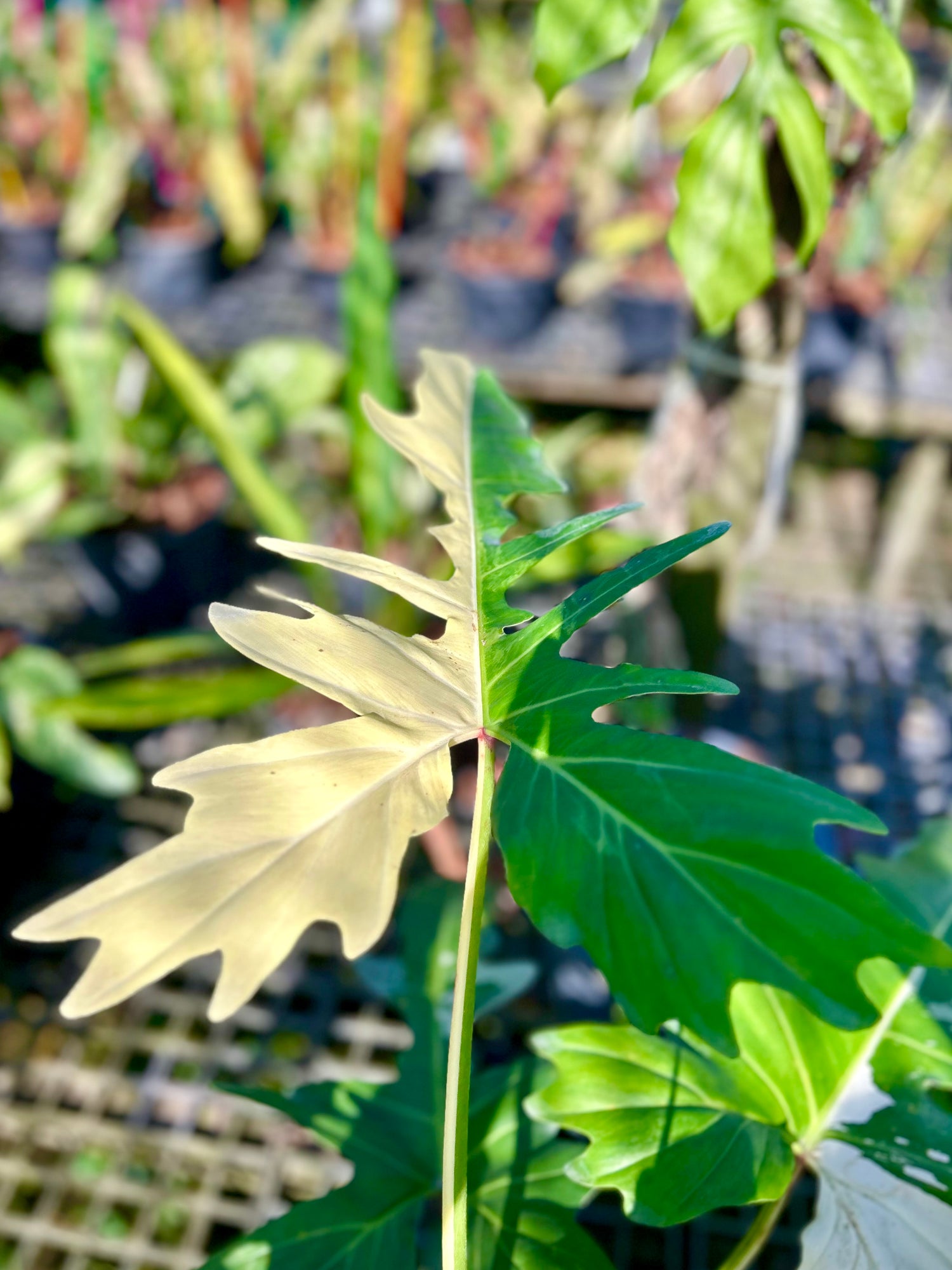
The leaf is the absolute signature of Alocasias . In most cases, it is large, graphic, often sagittate or hastate in shape, and it is precisely this structure that serves as the basis for identification.
Key variations to observe:
• General shape of the limb
• Depth of the lobes
• Smooth, bubbly, velvety, metallic texture
• Colors on the top and back
• Vein density and color
• Contrast between veins and limb
A very useful morphological basis to know, especially for enthusiasts who want to delve deeper: the leaf is typically supported by three main veins that define the anterior and posterior lobes. Then, the secondary veins and their arrangement provide very reliable clues.
When you start observing Alocasias like this, you change your perspective. You go from "it's beautiful" to "I understand what I'm looking at." And you'll see, it becomes addictive.
For SEO and for understanding the realities of the European market, this is also a key point, as many product descriptions mix up names or oversimplify. A trained eye will protect you.
🌱 Growth habit, stems, stolons: understanding how they grow
Not all Alocasias have the same architecture. Some remain compact, with short rhizomatous structures. Others develop robust, tall stems, forming a sort of trunk and a crown at the top.
We generally observe:
• Sequential growth, leaf by leaf
• A crown of foliage formed upwards
• A possible alternation between active phases and slower phases
Some species or individuals also produce stolons. These stolons can form bulbs, small underground tubers capable of producing new plants. And this is often when a plant addict loses their neutrality.
You discover a bulb, you hold it in your hand, and you feel like you've found a treasure. You're already picturing the future leaf. You begin to imagine the texture, the veins, the future. That's exactly how collections are born.
From a cultural perspective, understanding this system helps you to manage it better:
• Repotting
• The size of the pot
• Rest periods
• Multiplication
🌸 Inflorescence, pollination and thermogenesis: the science behind the mystery
The inflorescence of Alocasias is another strong marker. It consists of a spadix surrounded by a protective spathe.
The spathe is divided into two zones:
• A persistent lower part that protects the female and sterile areas
• A more ephemeral upper limb that often falls off after anthesis
A fascinating detail, and one of great biological importance: the female flowers mature before the male flowers. This strategy reduces self-pollination and promotes genetic diversity.
The spadix can also produce odors to attract pollinators. Depending on the species, this can range from:
• With a rather mild fragrance
• With an odor reminiscent of decomposition
And some Alocasias go even further: they can be thermogenic. The spadix generates heat, which helps to dissipate odors and attract pollinators, especially when the environment is cooler.
In cultivation, witnessing a flowering can evoke conflicting emotions in collectors:
• Pride because the plant feels good
• Stress because growth may slow down after
• Doubt because you wonder if you should change something
We've been there too. Today, we see it as a sign: the plant is stable, well-nourished, and confident.
🏞️ Ecological adaptations and diversity: why they don't all want the same thing
The morphological diversity of Alocasias is directly linked to their ecological adaptations. And this is where many overly generic guides fail.
Examples of adaptation:
• Some species adapt to mountain habitats
• Others prefer marshy areas
• Some are limited to specific substrates such as ultramafic soils
• Others tolerate limestone or sandstone rocks
In practice, this means that the term “Alocasia” is not enough to define a single culture. There are common needs, yes, but there are also nuances.
What almost always works in Europe is the following approach:
• Observe your plant more than your calendar
• Stabilize temperature and humidity
• Keep the substrate living, aerated, and never suffocating
• Avoid using pots that are too large
That's what we learned by testing, failing, and then mastering in a controlled environment .
🪴 Successful cultivation in France and Europe: substrate, fertilizer, light, watering
Alocasias are often described as difficult. In reality, they are mainly demanding in a few specific areas. If these are addressed, they become very rewarding.
🌿 Substrate
Alocasias like a rich substrate that retains moisture without becoming anaerobic.
An effective mixture for most cases:
- Perlite
- Maritime pine bark
- Clay pebbles
- Activated charcoal or biochar
- Pumice
Advanced options are also available:
• Semi-hydroponic cultivation with clay pebbles or mineral supports
And certain additives can help depending on the context:
• Humic acids
• Suitable mineral correctors
• Preventive amendments according to your conditions
This is exactly where many plant addicts lose plants: the substrate is too dense, the pot too big, the water stagnates, and everything falls apart.
At Green and White Plants, our premium substrates are cleaned three times to remove impurities.
🌱 Fertilization
Alocasias are heavy feeders. A simple approach works very well:
• Light fertilizer with each watering
• In low-dose mode regularly
Two main strategies:
• Fertilizer in the watering can
• Slow-release fertilizers in the substrate
If your ambient humidity is very low, fertilization should be lighter to avoid burning, especially with a high VPD.
🌡️ Temperature
Root temperature matters a great deal.
Practical guidelines:
• Bulb germination occurs at around 25 to 30 degrees
• Vegetative growth around 22 to 26 degrees
• Below 10 degrees, it's really dangerous
• Below 4 degrees, the risk of irreversible damage becomes real
💧 Humidity
A humidity level between 60 and 80 percent is ideal.
Some Alocasias can tolerate lower temperatures, but you will need to adjust the fertilizer and watch for leaf burn.
💦 Watering
Key point: the substrate must remain moist, but never saturated.
The right mindset:
• Humid, yes
• Soaked, no
• Never suffocating
💡 Light
Outdoors, a shade structure that filters a large part of the sun is often recommended.
Indoors, you need to aim for light that is truly effective for growth.
Simple guidelines:
• Medium light is sufficient to maintain
• Stronger light is needed for true growth
• Too little light slows everything down, even if the plant survives
🪴 Pot size
This is the number one mistake in Europe.
Alocasias dislike overly large pots. Unlike some other Araceae, their roots don't spread throughout the pot. They anchor themselves and then grow downwards, and an excess of damp potting mix around the rhizome promotes rot.
Simple rule:
• The pot must be adjusted to the rhizome and existing roots
• Just add a reasonable margin of substrate around
• A long, narrow pot is often better than a wide, short one
We were making the mistake of oversizing because the foliage was large. Now we're doing the opposite, and we've seen the difference.
🧪 Replication and propagation, offspring and hybridization
Alocasias multiply easily asexually.
You can obtain:
• Discharges
• Bulbs
• Rhizome divisions
When the plant is healthy, it can produce at an impressive rate.
Sexual reproduction, however, is a different story. Hybridization has a rich history dating back to the 19th century. It's more technical, but it's a way to create truly unique plants.
For most enthusiasts, starting with bulb propagation is already an incredible adventure.
🕷️ Pests, the silent nightmare of plant addicts
Even the finest collections can be caught off guard.
Alocasias often attract:
• Mites
• Thrips
And the worst part is, you don't always see them at first. You just see:
• A leaf that loses its texture
• Discolored spots
• Slowing growth
• A rib that deforms
At that point, your plant-addict brain goes into overdrive. Light, fertilizer, watering, substrate. And sometimes, the answer was just a discreet pest.
The key is consistency:
• Observe often
• Isolate if necessary
• React early
📊 Summary chart for successfully growing Alocasias
| Need | What your Alocasias prefer |
|---|---|
| Substrate | Airy, rich, humid without being suffocating |
| Jar | Small, fitted, rather long and narrow |
| Temperature | Hot, especially at the roots |
| Humidity | 60 to 80 percent ideal |
| Watering | Constantly damp, never soaked |
| Light | Indirect live, stable |
| Fertilizer | Low regular dose |
| Spread | Cormes, rejections, division |
| Risks | Mites, thrips, excess water |
🌿 In short
Alocasias are among the most beautiful and rare tropical plants you can grow in France and Europe . They will reward you if you provide them with a few basics: a suitable substrate , a well-sized pot, stable warmth, and a routine of observation.
If you would like personalized support:
• You can contact Green and White Plants via Instagram
https://www.instagram.com/greenandwhite_plants
• We are available 7 days a week to help you and answer your questions
• Suggest your blog topic ideas to us, and we'll write them for you and the entire community.
See also:
• Pre-orders
https://greenandwhiteplants.com/collections/precommande
• Stock in France, 24-hour delivery
https://greenandwhiteplants.com/collections/plantes-rares
• Our premium substrates, cleaned three times, have already been adopted by several hundred plant addicts and have saved more than 50 plant addicts.
https://greenandwhiteplants.com/collections/substrats
👉 Join us on Instagram: greenandwhite_plants 🌿✨