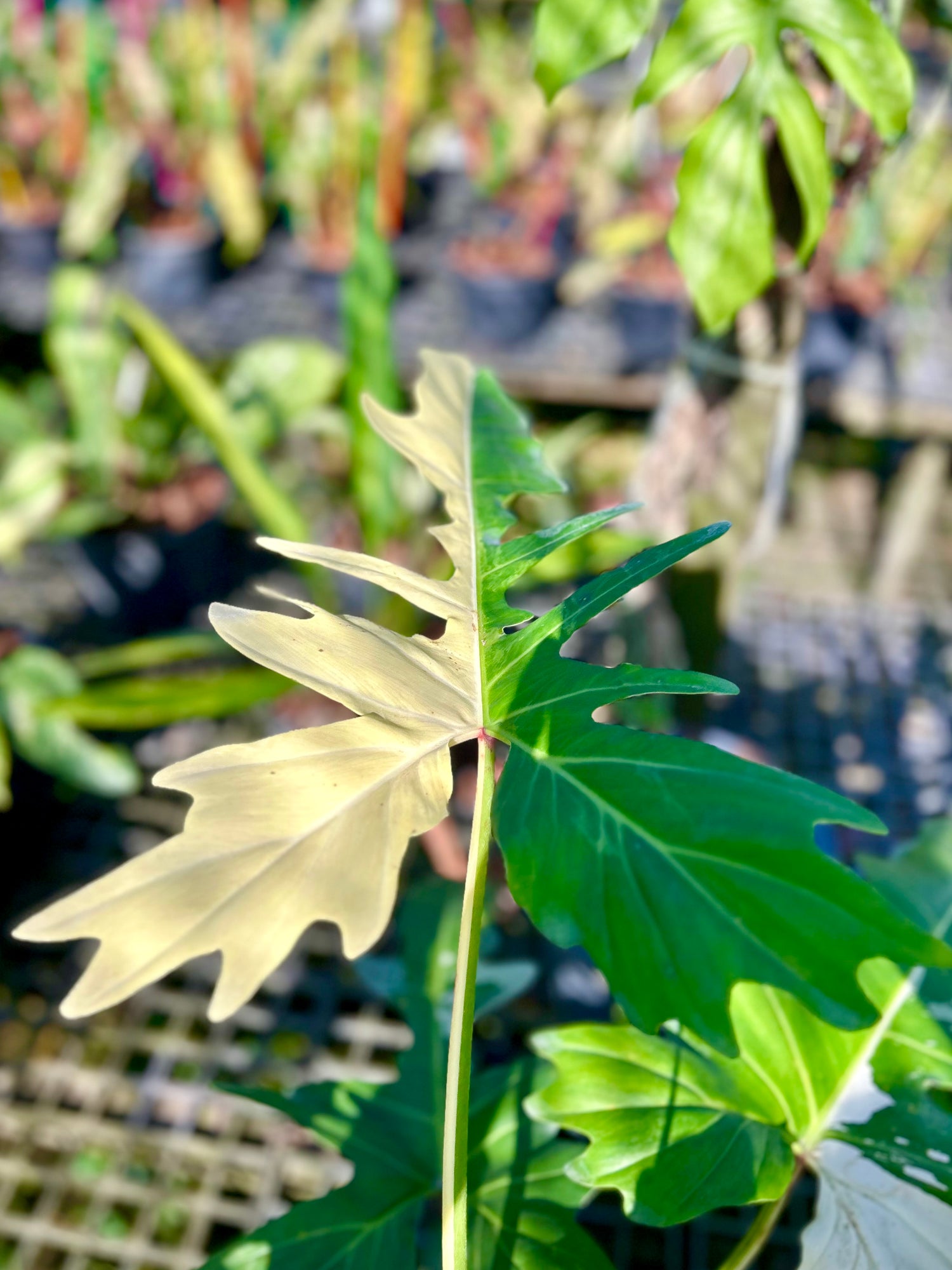


How to get more leaves on an alocasia?
Share
Understanding the actual functioning of an Alocasia
Before trying to multiply the leaves, one essential thing must be understood:
Alocasia functions differently from many houseplants.
It grows from a rhizome or a bulb.
Each new leaf requires an enormous amount of energy from the plant.
In traditional cultivation, Alocasia often retains:
-
4 to 6 active leaves
-
Then replace the old ones with the new ones
If your plant is stagnating, it's not by chance.
This generally means that a factor is limiting its potential.
1. Factor #1: The substrate
The production of new leaves depends directly on the root system.
A compacted substrate blocks oxygen, water absorption, and nutrient circulation
Result: the plant survives, but does not perform.
A structured and well-draining Alocasia substrate allows for:
-
Active root growth
-
Improved water stability
-
Optimized absorption
The combination of clay beads, perlite, biochar, pine bark and pumice creates this breathable environment.
If you want to give your plant a solid foundation to produce more leaves, you can find the right mix here:
https://greenandwhiteplants.com/products/substrat-alocasia-professionnel
2. Light: the engine of growth
Alocasia needs intense but indirect light.
Lack of light = Smaller leaves / Slow growth
Place it:
Near a bright window, out of direct sunlight, in a thermally stable room
In winter, move it closer to the light source.
3. Atmospheric humidity
Native to tropical Asia, the Alocasia loves humidity.
Air that is too dry leads to brown edges, stunted growth, and overall stress. Therefore, maintain high humidity.
4. Controlled watering
Many believe that watering more stimulates growth.
That's wrong.
Excess water:
-
Suffocates the roots
-
Slows down the plant
-
Prevents the production of new leaves
A well-draining substrate facilitates this management.
It allows for maintaining constant humidity without saturation.
To explore solutions adapted to rare tropical plants in Europe , you can consult here:
https://greenandwhiteplants.com/collections/substrats
5. Nutrition
An actively growing Alocasia consumes a lot of energy.
During the period from March to October:
-
Regular applications of liquid fertilizer
-
Winter discount
A deficiency manifests itself through:
-
Smaller leaves
-
Pale veins
-
Slow growth
6. The root space
If your plant is cramped:
-
She voluntarily limits her growth
-
It produces fewer leaves
Repotting into a slightly larger pot often revives the plant's growth.
7. Bulb/Corm Management
Corms are energy reserves.
If you let them grow in the same pot, they can strengthen the mother plant.
If you separate them, they can give rise to new plants.
To optimize this phase, a pot adapted to the growth of young roots can make all the difference:
https://greenandwhiteplants.com/products/root-starter
Why does your Alocasia only have three leaves?
This is a frequently asked question.
This could be due to:
-
From a substrate that is too dense
-
From a lack of light
-
From water stress
-
Of an unstable temperature
A well-established plant can maintain an incalculable number of leaves depending on the variety and maturity, but above all on the health of the roots.
Varieties and foliage potential
Some varieties are naturally more productive:
Alocasia zebrina, Alocasia 'Polly', macrorrhiza or portodora
The more mature the plant, the more dense foliage it can support.
The mistake that most collectors make
They seek to stimulate the visible part (leaves) without optimizing the invisible part (roots).
However, in the cultivation of rare tropical plants indoors , success always begins below the surface.
A strong root system = a plant capable of producing more.
In summary
To get more leaves on an Alocasia, you need to act on:
-
The well-draining and structured substrate
-
Intense indirect light
-
Atmospheric humidity
-
Regular nutrition
-
The root space
When these parameters are controlled, growth becomes spectacular.
To continue progressing in the cultivation of Alocasia and rare tropical plants , join us here: