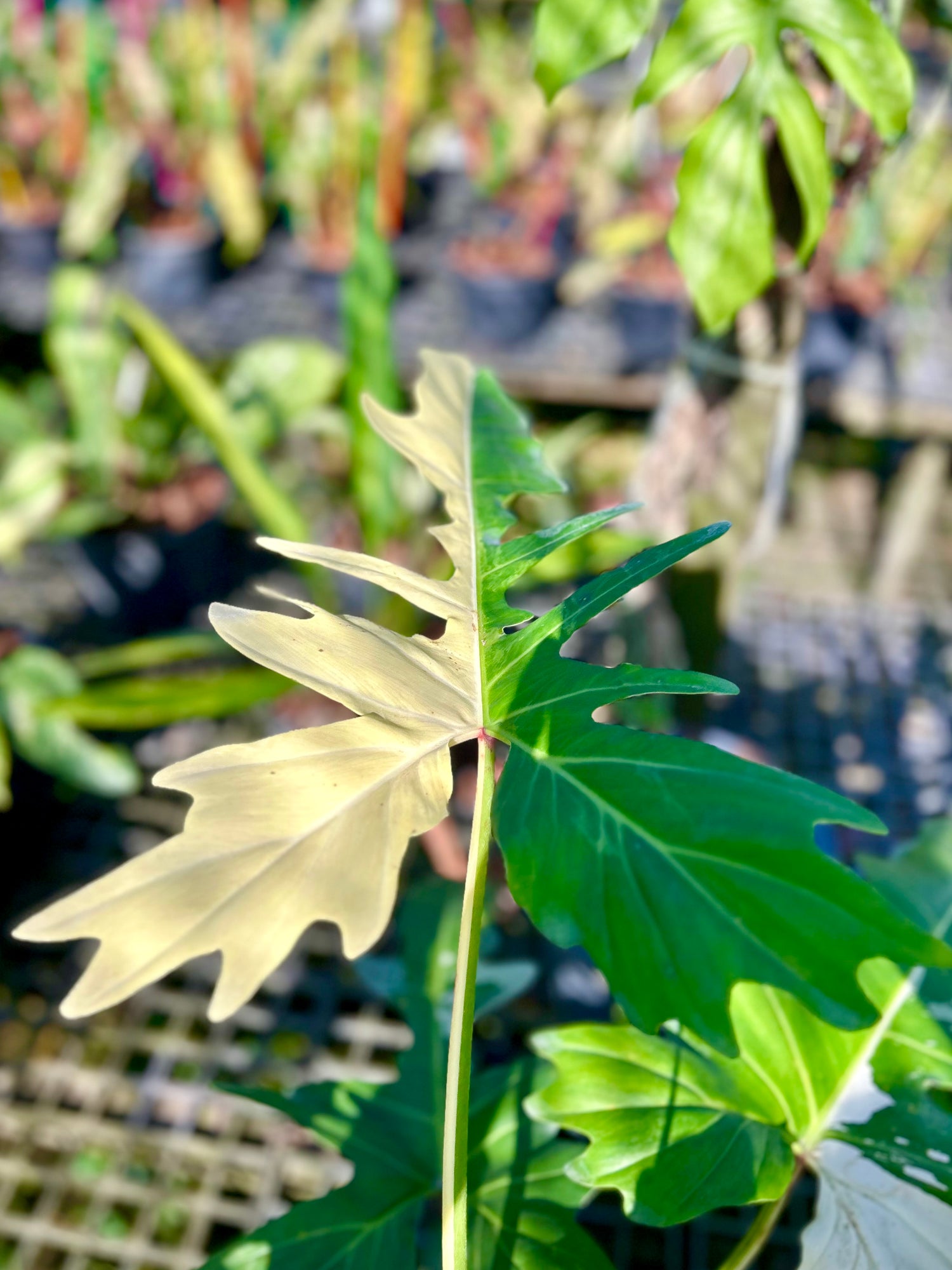


Alocasia Stingray rare cultivation advice France Europe
Alocasia macrorrhizos 'Stingray'
When a leaf becomes a silhouette and transforms an Alocasia into a living icon of rare tropical plants
Introduction
There are rare tropical plants that are recognizable by their color. Others by their size. And then there are those that immediately stand out because of their silhouette . Alocasia macrorrhizos 'Stingray' clearly belongs to this last category.
The first time you see one, your brain short-circuits a bit. A large, almost circular leaf, a wavy edge, a sculptural posture… and above all, that exaggeratedly elongated tip, like a plant whip. At that precise moment, everyone thinks the same thing: it's not a normal leaf.
At Green and White Plants, we discovered the Stingray at a time when we thought we already knew a lot about rare Alocasias . Today, grown in a controlled environment , the Alocasia Stingray has become a powerful symbol for us.
that of a spectacular plant, but one which requires a real understanding of its physiology and especially its root system.
Origin and discovery of the 'Stingray' cultivar
Alocasia macrorrhizos 'Stingray' is a mutant cultivar derived from the species Alocasia Macrorrhizos. Unlike some recent horticultural creations, its story begins directly in the field.
It was discovered in the Sarawak region of Malaysian Borneo , where several atypical forms were observed in small villages. It is not an isolated mutation on a single plant, but rather a stable variation found in several locations, which explains its ability to be subsequently propagated and preserved.
It was after its spread in Thailand that the Stingray really began to gain popularity. Thai growers quickly understood its visual potential. In the early 2000s, it arrived in the United States , where it quickly became a sought-after plant for collectors of rare tropical plants .
Today, in France and Europe, it stands out as an iconic Alocasia, instantly recognizable, even by people unfamiliar with the genre.
Botanical description and morphological characteristics
What makes Alocasia macrorrhizos 'Stingray' unique is a combination of very marked morphological characteristics.
Main features
• Leaf with an orbicular (circle-shaped, ring-shaped*) to sagittate ( arrowhead-shaped, spearhead-shaped*) shape , often wide
• Deeply wavy margins
• Blade slightly curved in cross-section
• Soft yet structured texture
• And above all, an abnormally elongated apex , called a drip tip
It's that famously exaggerated drip tip that gives it its name. The foil immediately evokes the silhouette of a manta ray , with a thin, elongated tail that seems to float in the air. In motion, with a slight breeze, the effect is almost hypnotic.
The petiole is robust, often green to light green, capable of supporting large leaves. The plant can quickly grow in size, making it a spectacular tropical plant , but also one that demands respect for space.
Why does the Stingray fascinate plant addicts so much?
There is a phenomenon that we often observe among enthusiasts of rare tropical plants
The Stingray either provokes an immediate infatuation or a gradual obsession.
For what ?
Because it doesn't resemble any other classic houseplant.
For a collector, it ticks several boxes
• stable natural mutation
• immediately identifiable silhouette
• rapid growth under good conditions
• strong visual presence even without variegation
And unlike some ultra-rare plants, it remains accessible , which often makes it a gateway to more technical Alocasias.
We have seen many plant addicts come back to us after an initial failure with a classic Alocasia, succeed with a well-established Stingray, and then regain confidence.
Difference between Alocasia macrorrhizos and the 'Stingray' cultivar
It is essential to understand that the Stingray remains a macrorrhizos in its general behavior, even if its appearance is very different.
Major differences
• The shape of the leaf is radically different
• The drip tip is absent in classic macrorrhizos
• The visual reading of the plant is more aerial.
However, their basic needs remain close
• heat
• bright indirect light
• draining substrate
• roots never cold
This is often where mistakes begin. Stingray is treated as a robust decorative plant, when it remains a rare tropical plant sensitive to root stress .
Cultivation of Alocasia Stingray in France and Europe
Good news
Alocasia macrorrhizos 'Stingray' grows very well in France and Europe, provided that a few simple but non-negotiable rules are respected.
Ideal conditions
• Stable temperature between 20 and 28 degrees
• Bright, indirect light, never scorching sun
• Ambient humidity around 60 to 75 percent
• Good air circulation without cold drafts
• Regular but controlled watering
The most frequent mistake remains thermal shock . Many losses occur in autumn or winter, when the roots remain moist while the temperature drops.
That's exactly what we were doing at the beginning. Today, in a controlled environment, we understand that stability takes precedence over everything else.
Substrate and root management: the real secret of Stingray
If you had to remember just one thing
The substrate for rare tropical plants is the absolute key with the Stingray.
This Alocasia develops a powerful, voluminous root system that needs
• oxygen
• rapid drainage
• of fine but constant humidity
• of a substrate that never compacts
A mixture that is too rich or too thin quickly leads to
• roots suffocated
• soft leaves
• sudden leaf drop
It is precisely for this reason that our premium substrates, cleaned three times, have already saved dozens of plant addicts and satisfied hundreds of enthusiasts looking for a substrate truly suited to rare tropical plants . On a Stingray, the difference is visible in just a few weeks.
Growth, pace and daily maintenance
Under optimal conditions, the Stingray grows fast. Very fast.
What you can observe
• a new leaf every few weeks during the warm season
• increasingly larger leaves
• an increasingly sculptural port
Maintenance recommended
• Regular cleaning of the leaves
• Monitoring for common Alocasia parasites
• Light but regular fertilization during the growth period
• Relative rest in winter without excess water
Many plant enthusiasts panic when growth slows down. That's normal. Stingray clearly marks the seasons, even indoors.
Botanical and horticultural summary
| Element | Detail |
|---|---|
| Name | Alocasia macrorrhizos 'Stingray' |
| Kind | mutant cultivar |
| Origin | Sarawak, Borneo |
| Special feature | elongated drip tip in the shape of a ray |
| Level | From motivated beginner to passionate |
| European Culture | Yes, with a suitable substrate |
In short
Alocasia macrorrhizos 'Stingray' is much more than a decorative plant. It is an iconic, rare tropical plant , instantly recognizable, that rewards those who understand its basic needs. In France and Europe, it becomes a stable, vigorous, and spectacular plant as soon as three key principles are respected.
warmth, soft light and a perfectly aerated substrate.
Need personalized support
You can contact Green and White Plants via Instagram
https://www.instagram.com/greenandwhite_plants
We are available 7 days a week to help you, answer your questions and support you on your plant addict journey.
You can also suggest your blog topic ideas to us; we will write them for you and for the entire community.
We also offer this variety:
Alocasia Macrorrhizos Stingray Aurea Variegata - Bulb:
https://greenandwhiteplants.com/products/alocasia-stingray-aurea-variegata-bulbe
Looking to expand your collection of rare tropical plants?
• Pre-orders
https://greenandwhiteplants.com/collections/precommande
• Stock in France, 24-hour delivery
https://greenandwhiteplants.com/collections/plantes-rares
Need for a substrate truly suited to tropical plants
• Premium substrates cleaned three times
https://greenandwhiteplants.com/collections/substrats
👉 Join us on Instagram: greenandwhite_plants 🌿✨