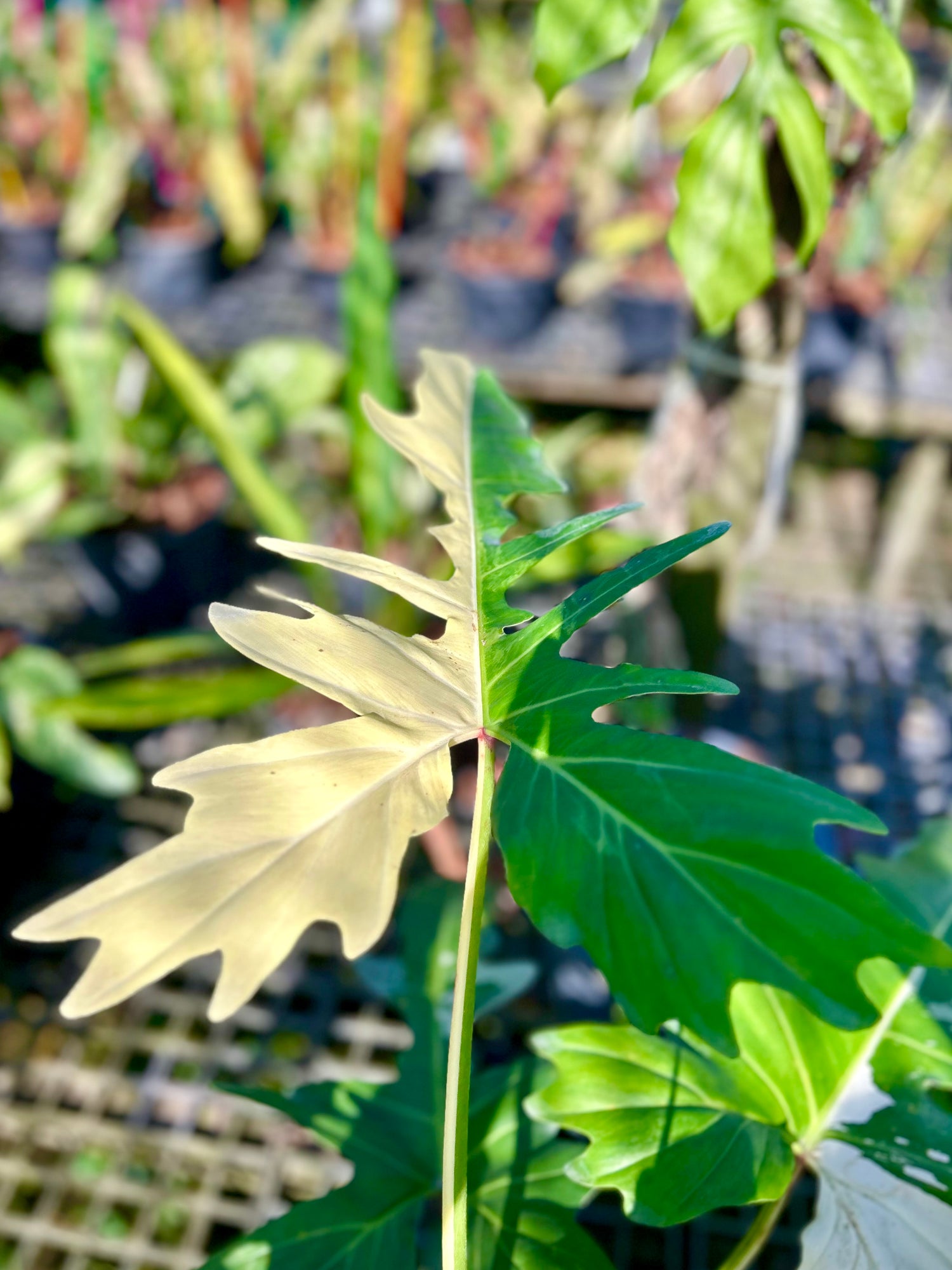


Alocasia Serendipity rare dark tropical plant
Alocasia 'Serendipity'
A chance discovery, a unique identity, and a mysterious aura for collectors of rare tropical plants
🌱 Introduction
There are plants that you search for for years. And then there are those that find you unexpectedly.
The Alocasia 'Serendipity' is one of those rare, almost improbable encounters that leave a lasting mark on a plant addict 's journey. A plant that was meant to go unnoticed, placed in an obscure nursery with a simple handwritten label… and which ends up becoming an absolute reference in the world of rare tropical plants .
At Green and White Plants, it's precisely these stories that resonate with us. Because we've lived them. When we started comparing, observing the details, and today, every morphological difference becomes valuable information.
The Alocasia 'Serendipity' is not just beautiful. It's intriguing. It encourages observation, doubt, and comparison. And that's precisely what makes it so addictive.
🔍 A chance discovery by LariAnn Garner
The story begins with LariAnn Garner , a renowned hybridizer and founder of Aroidia Research . She discovered this plant in a little-known nursery, under a minimalist label that simply stated:
• Alocasia “Black Stem”
At first glance, the plant seemed similar to Alocasia macrorrhizos 'Plumbea' , known for its dark petioles. But very quickly, LariAnn noticed that something wasn't quite right. The plant was different. More subtle. More complex.
She notes similarities with:
• Alocasia alba
• Alocasia sarawakensis
In particular with the latter, with which it shares certain morphological traits. Initially, it was considered a dark chimeric form and provisionally named it Alocasia sarawakensis 'Dark' , thinking of a pigmentary variation comparable to that of Alocasia macrorrhizos 'Plumbea' , formerly and wrongly called plumbea 'Nigra' .
But the more she observes, the more doubt sets in.
🧬 From supposition to proper identity
LariAnn takes the analysis further. She observes the texture of the leaf blade, the exact coloration of the faces, the presence of micro-hairs, and above all the structure of the inflorescence.
His conclusions are clear:
This plant is not simply a variation of Alocasia sarawakensis.
She then introduced the plant into in vitro culture in 2015 , allowing for stable production and observation over several generations. At that point, she gave it its definitive name:
👉 Alocasia 'Serendipity'
A perfectly chosen name, which refers to the way the plant was discovered, by pure happy accident.
🍃 General morphology and visual signature
At first glance, Alocasia 'Serendipity' resembles some large, elegant Alocasias. But upon closer inspection, the differences become apparent.
Distinctive features:
• Slightly blistered leaves, with a crumpled appearance
• Bronze-red coloration on the adaxial and abaxial faces
• Presence of a fine downy fuzz on the underside, peach fuzz type
• More vibrant texture than the smooth leaves of sarawakensis
• Balanced build, neither too bulky nor too thin
Unlike Alocasia sarawakensis , whose leaves are smooth, Serendipity has a textured, almost breathable surface. This detail is essential for identification.
This is exactly the kind of plant that reveals its full personality when you take the time to observe it from different angles and in different lights.
🎨 Current Variations and Debates
The Alocasia 'Serendipity' is sometimes offered on the market in variegated versions:
• Pink variegation
• White variegation
However, one important point must be emphasized. It is not yet confirmed that all variegated plants currently sold under this name are actually true Alocasia 'Serendipity'.
In a very active European market for rare tropical plants , this kind of ambiguity exists. And that's precisely why we always emphasize:
• Traceability
• Morphological consistency
• Observing fine details
A true variegated Serendipity retains its bubbly texture and abaxial down, even in the presence of variegation.
🌡️ Growing conditions in France and Europe
One of the advantages of Alocasia 'Serendipity' is its relatively stable behavior in culture.
Ideal conditions:
• Temperature between 20 and 28 degrees
• Avoid any prolonged fall below 15 degrees
• Humidity around 60 to 75 percent
• Bright indirect light
• Water regularly but not excessively
In our early days, we often made the mistake of overwatering dark-leaved Alocasias, thinking they necessarily came from saturated environments. Today, we know that root respiration is far more important than the quantity of water.
🪴 Substrate and root health
Like many tropical collector plants , Serendipity needs a structured substrate.
A good substrate should:
• Be well-ventilated
• Retain moisture without stagnation
• Promote healthy root growth
That's precisely why we offer our premium substrates, cleaned three times . They've already saved dozens of plant addicts and satisfied over 100 enthusiasts looking for a substrate truly suited to rare tropical plants .
We saw a clear difference in Serendipity as soon as we switched to a more breathable substrate. The leaves emerged more uniform, more textured, and more stable.
🧠 The plant addict's experience with Serendipity
With the Alocasia 'Serendipity' , one often encounters:
• The fascination linked to its discovery
• Doubt about his exact identity
• Careful observation of each new leaf
• The profound satisfaction when the plant takes root
It's a plant that invites you to slow down. To look. To compare. And for many enthusiasts, that's exactly what they look for in a rare tropical plant .
📊 Summary table
| Element | Detail |
|---|---|
| Name | Alocasia 'Serendipity' |
| Kind | modern horticultural cultivar |
| Discovery | LariAnn Garner |
| in vitro introduction | 2015 |
| Signature | blistered leaves, abaxial down |
| Coloring | Dark bronze red |
| Variations | Rose, white, not confirmed |
| Level | Passionate collector |
🌿 In short
Alocasia 'Serendipity' is a plant born by chance, but which has become a benchmark. Its unique morphology, its modern history and its mysterious aura make it a rare tropical plant that is a must-have for collectors in France and Europe .
Need advice or personalized support?
• Contact Green and White Plants via Instagram
https://www.instagram.com/greenandwhite_plants
• We are available 7 days a week to help and answer your questions
• Suggest your blog topic ideas to us, and we'll write them for you and the entire community
Looking to expand your collection
• Pre-orders
https://greenandwhiteplants.com/collections/precommande
• Stock in France, 24-hour delivery
https://greenandwhiteplants.com/collections/plantes-rares
Need for a truly suitable substrate
• Our premium substrates
https://greenandwhiteplants.com/collections/substrats
👉 Join us on Instagram: greenandwhite_plants 🌿✨