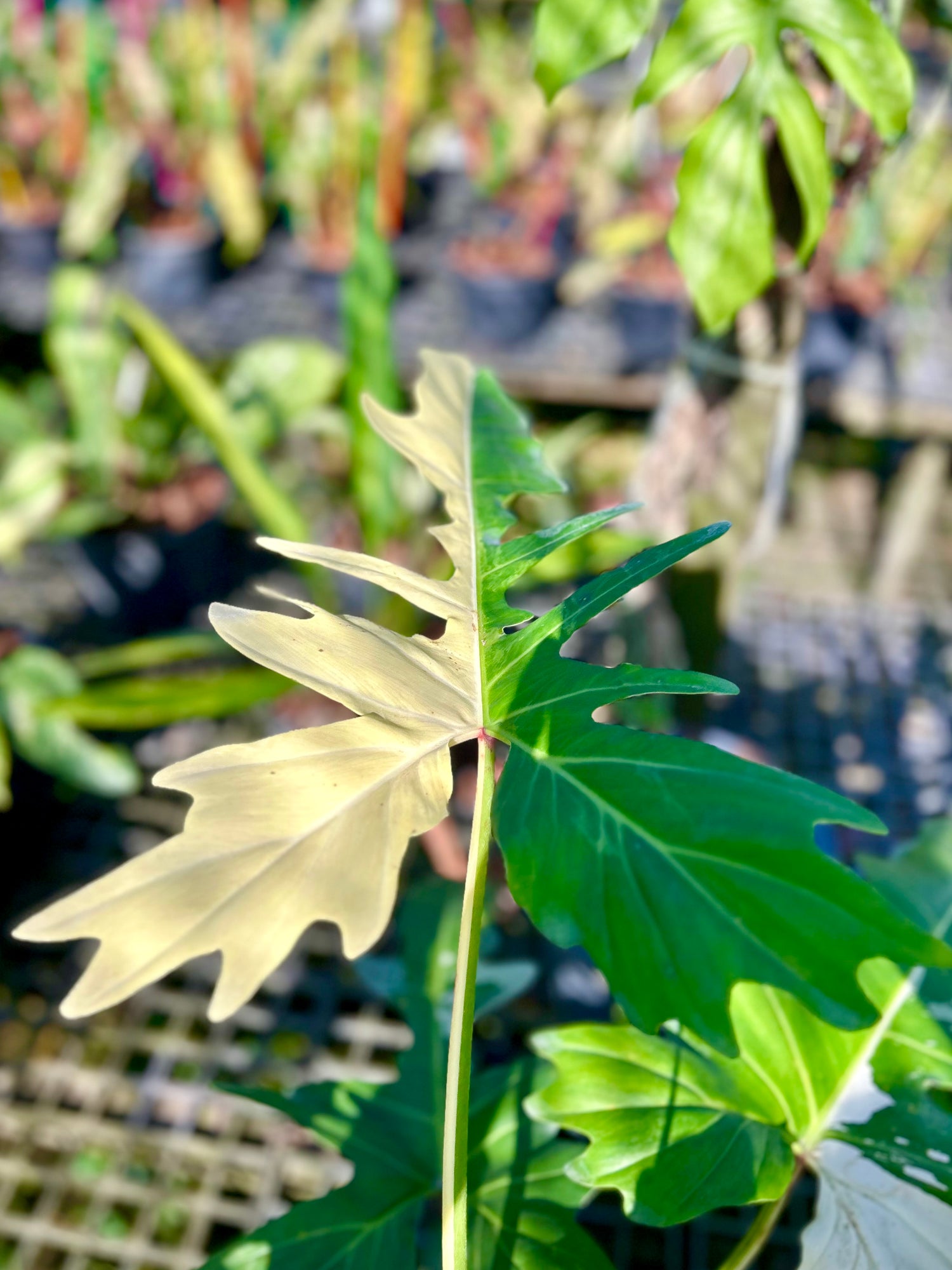


Alocasia Sarian rare tropical plant Philippines Europe
Alocasia 'Sarian'
Native to the Philippines, its botanical identity is debated, and it's an unsung treasure among rare tropical plants.
🌱 Introduction
There are plants that are talked about for their variegation. Others for their spectacular size. And then there are those that fascinate us because of their history , their true origin , and the debates they still provoke today.
The Alocasia 'Sarian' clearly belongs to the latter category.
At Green and White Plants, we have a special connection to these rare tropical plants whose identity is not fixed, but dynamic. Plants that compel us to slow down, to read, to compare, to understand. We first encountered this species when we were still growing plants in an apartment, with many questions and few certainties. Then, in a house, some answers began to emerge. And today, in a controlled environment , we understand why Alocasia 'Sarian' is unlike any other.
This article is a complete dive into his world, between botany, human history, ecology and culture in France and Europe , always with the gaze of a plant addict who observes, doubts, then becomes deeply attached.
🌍 Geographic origin and natural distribution
Alocasia 'Sarian' is a plant native to the Philippines , more specifically to the province of Ilocos Norte , located on the island of Luzon , in the north of the archipelago.
A key point to understand
Contrary to what can be read on many online sources, Alocasia 'Sarian' is not a horticultural hybrid . It has a geographically widespread natural population, clearly distinct from the species with which it has been attempted to be crossed on paper.
This Philippine origin is a central element of its identity and largely explains its morphology, behavior, and ability to adapt to different cultures.
🌡️ Natural climate and environmental conditions
The natural environment of Alocasia 'Sarian' corresponds to a humid tropical climate , relatively moderate compared to some extreme equatorial zones.
Observed climatic conditions:
• Stable humidity around 60 to 70 percent
• Daytime temperatures between 9 and 31 degrees
• Minimum temperatures never below 7 degrees
• Wet season from October to May
• Drier season from June to October
• Average annual rainfall of approximately 1,200 mm
This data explains why Alocasia 'Sarian' is relatively tolerant in European cultivation, as long as stability is maintained. It does not require a saturated atmosphere, but rather a consistent balance, with a breathable substrate and good aeration.
🌱 Ecology and altitudinal distribution
One particularly interesting point concerning Alocasia 'Sarian' is its distribution at altitude.
Key observations:
• Found up to an altitude of approximately 850 meters
• Absent beyond this limit
• Coexists locally with Alocasia micholitziana at this precise altitude
This detail is crucial. It shows a clear ecological separation between the two species. Alocasia 'Sarian' occupies its own ecological niche and does not descend below this zone, while Alocasia micholitziana is never observed further down.
This behavior strongly rules out the hypothesis of a natural hybrid , as areas of reproductive overlap are non-existent.
🍃 General morphological description
Although the species is not yet formally described taxonomically, Alocasia 'Sarian' exhibits consistent and recognizable morphological characteristics.
Distinctive features observed:
• Thin, slightly rubbery textured leaves
• Deeply sinuous margins of the limb
• Insertion of the petiole at the junction of the posterior lobes
• Lack of a velvety texture
• Robust but balanced weight
These elements allow it to be clearly differentiated from species often wrongly cited as supposed relatives.
🔍 Why Alocasia 'Sarian' is not a hybrid
For years, many sources claimed that Alocasia 'Sarian' was a cross between Alocasia zebrina and Alocasia micholitziana . This hypothesis was formally corrected by Zacarias Sarian himself.
Key arguments:
• Natural populations do not geographically overlap
• The leaf textures are incompatible
• The margins of the leaves differ profoundly
• The petiole insertion is distinct
• No signs of hybrid vigor
In summary, Alocasia 'Sarian' shows no signs of natural hybridization .
🎨 Variegated forms and horticultural interest
Alocasia 'Sarian' exists in variegated forms of yellow , mint, and white. Particularly sought after in Europe.
Characteristics of variegation:
• Variegated Aurea, Mint, Ablo
• Variable expression depending on the conditions
• Highly graphic foliage
• High collector value
This variegation, combined with the plant's unique history, makes it a rare tropical collector's plant , prized as much for its aesthetics as for its botanical story.
🧬 Hybridization and offspring
Although not a hybrid itself, Alocasia 'Sarian' has been used in hybridization.
Known hybrid:
• Alocasia 'Saridora'
Cross between Alocasia odora and Alocasia 'Sarian'
This confirms that Sarian is fertile and fully integrated into the gene pool of the genus Alocasia, unlike some sterile modern hybrids.
🌡️ Culture in France and Europe
In cultivation, Alocasia 'Sarian' is more accessible than one might think.
Ideal conditions:
• Temperature between 18 and 28 degrees
• Humidity around 60 to 70 percent
• Bright indirect light
• Regular but controlled watering
• Aerated and stable substrate
We have learned over time that it reacts very poorly to excesses, but extremely well to consistency. In a controlled environment, growth becomes regular and predictable.
🪴 Substrate and root health
Like all rare tropical plants , Alocasia 'Sarian' is highly dependent on its substrate.
A suitable substrate must:
• Be very well ventilated
• Avoid any stagnation of water
• Promote root oxygenation
Our premium substrates, cleaned three times, have already saved dozens of plant addicts and satisfied more than a hundred enthusiasts looking for a substrate truly suited to rare tropical plants .
This is one of the most effective levers for Sarian's long-term success.
🧠 A plant addict's reaction to Alocasia 'Sarian'
With Alocasia 'Sarian', one often feels:
• Curiosity related to his vague identity
• Doubt in the face of contradictory information
• The pleasure of observing a stable and consistent plant
• The pride of cultivating an authentic native species
It is a plant that nourishes the mind as much as the eyes.
📊 Summary table
| Element | Detail |
|---|---|
| Name | Alocasia 'Sarian' |
| Origin | Ilocos Norte, Luzon, Philippines |
| Status | Undescribed species or variety of macrorrhizos |
| Climate | Tropical rainforest |
| Altitude | Up to 850 m |
| Variety | Aurea, Mint, Albo |
| Fertility | Yes |
| Known hybrid | Alocasia 'Saridora' |
🌿 In short
Alocasia 'Sarian' is a fascinating plant, at the crossroads of botany, human history and horticultural passion. Native to the Philippines, long misunderstood, it is now establishing itself as a leading rare tropical plant for collectors in France and Europe .
Need personalized advice or support?
• Contact Green and White Plants via Instagram
https://www.instagram.com/greenandwhite_plants
• We are available 7 days a week to help and answer your questions
• Suggest your blog topic ideas to us, and we'll write them for you and the entire community
Looking to expand your collection
• Pre-orders
https://greenandwhiteplants.com/collections/precommande
• Stock in France, 24-hour delivery
https://greenandwhiteplants.com/collections/plantes-rares
Need for a truly suitable substrate
• Our premium substrates are cleaned three times
https://greenandwhiteplants.com/collections/substrats
👉 Join us on Instagram: greenandwhite_plants 🌿✨