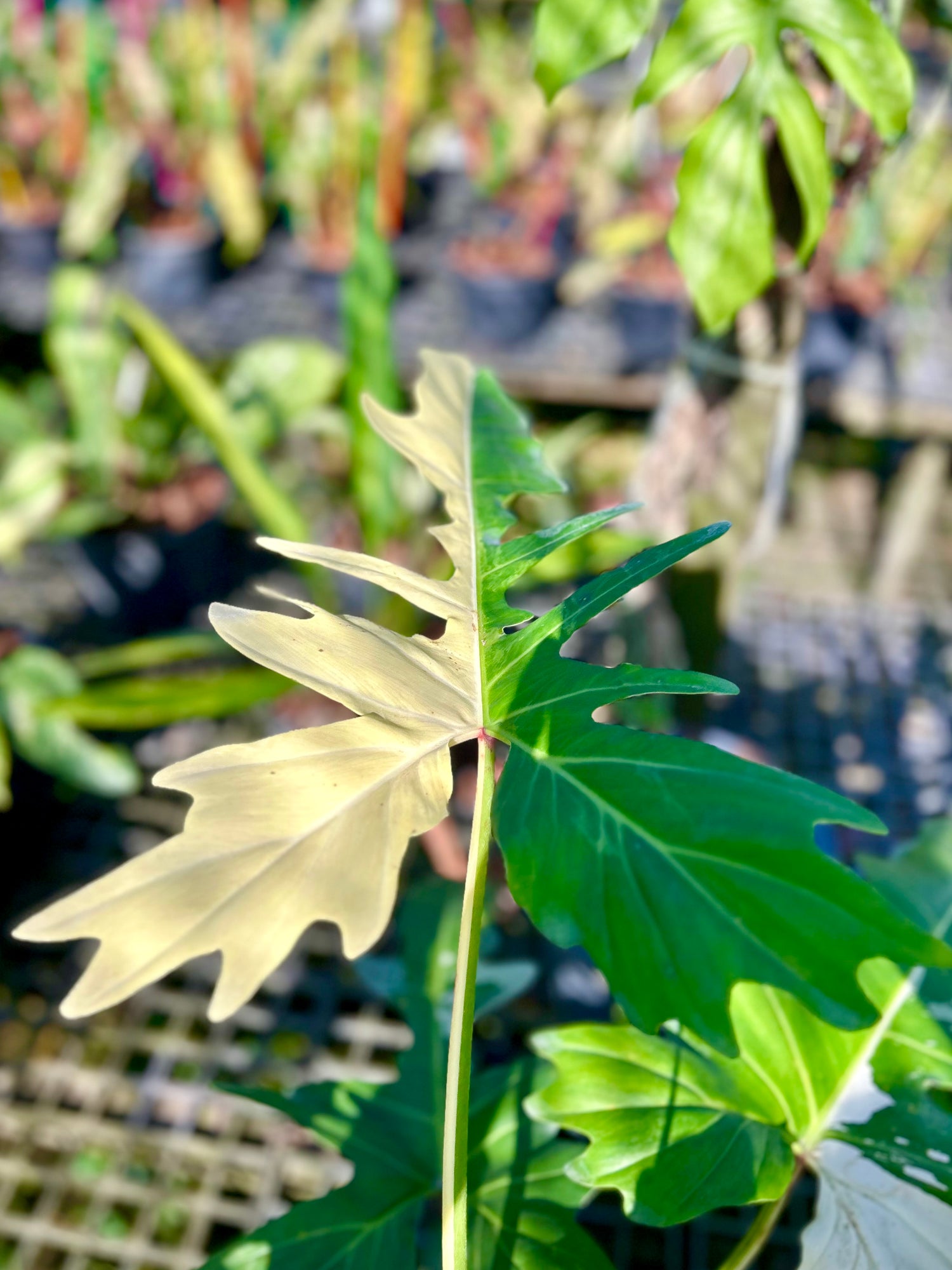


Alocasia Sanderiana - a rare tropical plant: origin and cultivation
🌿✨ Alocasia Sanderiana
A botanical icon of rare tropical plants, between history, science and passion
🌱 Introduction
There are plants that transcend time without ever losing their aura.
Alocasia sanderiana is one of those mythical species that immediately evokes something in lovers of rare tropical plants . A raw emotion. A mixture of respect and fascination.
We remember our first encounter with it very well. A demanding, almost capricious plant that offered no forgiveness. Every new leaf was a victory. Every instance of water stress a challenge. Today, it's cultivated professionally in a controlled greenhouse environment , where Alocasia sanderiana finally reveals its full potential.
This plant cannot be possessed. It must be understood. And that is precisely what we are going to convey to you.
🌍 Geographic origin and natural distribution
Alocasia sanderiana is a botanical species native to the Philippines , more specifically to the island of Mindanao .
This information is essential, as it shapes his entire culture.
Contrary to many misconceptions, it does not come from extreme marshy areas, but from ancient forests , often located at low altitudes , in damp ravines where water circulates without ever stagnating.
This natural environment explains why so many European plant enthusiasts encounter difficulties during their first attempts at cultivation. We made the same mistakes. Too much water. Not enough aeration. An unsuitable substrate.
🌡️ Natural climate and environmental conditions
Mindanao has a humid tropical climate , but remarkably stable.
• Average humidity between 60 and 70 percent year-round
• Daytime temperatures between 9 and 31 degrees
• Minimum temperatures never below 7 degrees
• Alternating between a wet season from October to May and a drier season from June to October
This is exactly the type of stability we sought to reproduce in the greenhouse. And it's often what's lacking indoors, especially in Europe.
🌱 Ecology and natural habitat
In nature, Alocasia sanderiana grows in damp forest ravines , sheltered from direct sunlight, but never in darkness.
The roots breathe.
The water is circulating.
The air is in motion.
This is where many enthusiasts go wrong. Too much humidity without ventilation can be more destructive than slightly drier air.
We have seen plants recover solely due to improved ventilation, without changing anything else.
🍃 Botanical description of Alocasia sanderiana
Alocasia sanderiana is a moderately robust herbaceous plant, which can reach about 60 cm in height .
Main features:
• Creeping to slightly prostrate stem
• Deep, glossy, arrow-shaped leaves
• Underside of leaves often purple
• Primary veins white to yellowish
• 3 to 4 primary veins per side, rarely 5
• Deeply wavy margins
• Petiole can reach 60 cm
Each wild specimen exhibits significant morphological variability . This is a fundamental point.
Plants grown in vitro that are found in collections are much more uniform, sometimes at the expense of their character.
🌿 Natural variability and confusion with hybrids
On the island of Mindanao, the leaves of Alocasia sanderiana can radically change in shape, color, and veining.
Some wild populations have leaves that are surprisingly similar to those of cultivated Alocasia 'Amazonica' . Yet, these are indeed plants in situ , observed in nature.
To differentiate between them:
• Alocasia sanderiana
• 3 to 4 primary veins
• Deeper lobes
• Fewer silvery secondary veins
• Alocasia 'Amazonica'
• 5 or more ribs
• More numerous white or silver veins
• Visible influence of Alocasia longiloba
This distinction is crucial for collectors of rare tropical plants in Europe , especially on the resale market.
🌸 Inflorescence and reproduction
The inflorescence of Alocasia sanderiana is often discreet but fascinating to enthusiasts.
• Inflorescences usually in pairs
• Greenish spathe, 6 to 10 cm long
• Greenish-white spadix shorter than the spathe
• Clearly distinct female zone
• Pointed stigmata with distinct lobes
In home cultivation, inflorescence is rare. In a controlled greenhouse, it becomes more frequent, a sign of a stable and suitable environment.
🌱 Variegated shapes and horticultural appeal
Variegated forms of Alocasia sanderiana exist, observed both in culture and exceptionally in situ .
These forms are highly sought after on the rare tropical plant market, but they require:
• Perfect stability
• Controlled lighting
• A breathable substrate
• Great patience
We've seen variegation disappear and then reappear after several months. It's a lesson in patience, the kind only Alocasia plants know how to teach.
🧬 Etymology and horticultural history
The species is dedicated to Henry Frederick Conrad Sander , a major figure in 19th-century European horticulture and founder of one of the largest nurseries of his time.
As early as 1884 , Alocasia sanderiana was being sold for 2 guineas , which is about 179 pounds or 207 dollars today .
Even back then, it was considered an exceptional plant.
It was subsequently used extensively in hybridization, giving rise to some of the most iconic Alocasias in our modern collections.
🌱 Status, synonyms, and taxonomic confusion
Homotypic synonyms:
• Alocasia sanderi
• Alocasia sanderiana var. nobility
• Alocasia urdanetensis
Heterotypical synonym:
• Schizocasia sanderiana
The name Alocasia sanderiana var. nobilis is not an accepted cultivar, but remains extremely widespread on the current market.
This confusion is common, and we encounter it regularly with our clients.
🪴 Our Green and White Plants Experience
We cultivated Alocasia sanderiana :
• In an apartment
• At home
• And today in a professional greenhouse with a controlled environment
Each step taught us that the substrate makes all the difference.
Our premium substrates, cleaned three times, have already saved more than 50 plant addicts and satisfied more than 100 enthusiasts in Europe looking for a substrate truly suited to rare tropical plants .
📊 Summary table
| Element | Detail |
|---|---|
| Origin | Philippines, Mindanao |
| Climate | Stable humid tropical climate |
| Humidity | 60 to 70 percent |
| Temperature | 9 to 31 degrees |
| Variability | Very high in situ |
| Rarity | Rare tropical plant |
| Use | Collection and hybridization |
🌿 In short
Alocasia sanderiana is an exceptional botanical plant.
It embodies horticultural history, scientific rigor and the raw emotion of the plant addict .
If you would like to be accompanied:
• We are available 7 days a week
• Contact us on Instagram
👉 https://www.instagram.com/greenandwhite_plants
Suggest your blog topic ideas to us. We write for you and for the entire community.
You can find our Alocasia Sanderiana bulbs here!
Pseudo Sanderiana Aurea Variegata:
Nickname Sanderiana Pink Variegata:
https://greenandwhiteplants.com/products/alocasia-pseudo-sanderiana-pink-bulbes
Sanderiana Bull Pink Variegata:
https://greenandwhiteplants.com/products/alocasia-bull-pink-variegata-bulbe-plante-tropicale-rare
Also check out:
• Pre-orders
https://greenandwhiteplants.com/collections/precommande
• Stock in France, 24-hour delivery
https://greenandwhiteplants.com/collections/plantes-rares
• Premium substrates cleaned three times
https://greenandwhiteplants.com/collections/substrats
👉 Join us on Instagram greenandwhite_plants 🌿✨