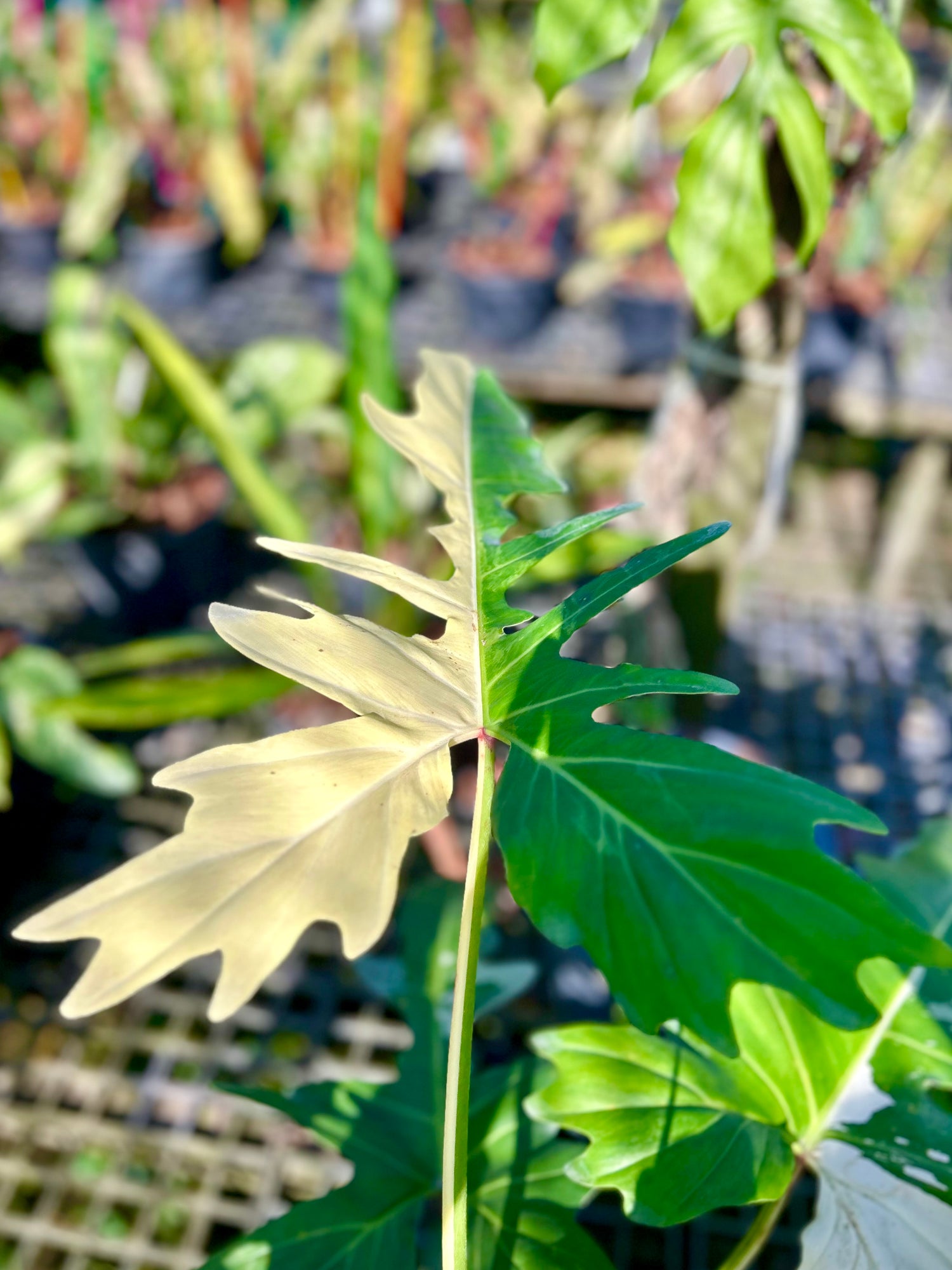


Alocasia portei rare giant tropical plant
Alocasia portei
Mythical giant of the Philippines, botanical icon and absolute fascination for collectors
Introduction
There are rare tropical plants that impress with their delicacy. And then there are those that command silence with their sheer size . Alocasia portei undoubtedly belongs to this second category. It is a plant that transcends the simple realm of horticulture. It embodies the power of the plant world, tropical grandeur, and an era when botany was still a matter of pure exploration.
The first time we saw a true Alocasia portei , it wasn't in a home culture. It was a mature, massive, almost tree-like plant. At that precise moment, we understood that some Alocasias aren't meant to be "owned," but observed and respected . Today, with the benefit of hindsight regarding cultivation in controlled environments , portei remains for us an absolute benchmark, a plant that represents a pinnacle in the world of rare tropical plants in Europe .
Original description and historical context
Alocasia portei was first described in 1862 in Bonplandia , a German botanical journal. The original description was based on a single dried leaf , transmitted by Hermann Wendland. The author himself expressed a certain caution, mentioning a probable but not absolutely certain attribution to the genus Alocasia , hence the initial mention Alocasia? (Schizocasia) portei .
This detail is revealing of the era. The plant's colossal size made a complete collection extremely complex. No complete type specimen has been preserved. The officially accepted neotype is a drawing prepared at Schott's request , depicting only a leaf. Despite this, this representation perfectly matches the current understanding of the species.
Synonymy and taxonomic position
Alocasia portei has a relatively clear synonymy.
Homotypic synonyms
• Schizocasia portei
Heterotypical synonyms
• Schizocasia regnieri
The name Schizocasia regnieri appears to differ only in a yellowish coloration of the petioles and main veins, which remains within the normal variability of such a large species. These differences were not deemed sufficient to justify separate classification.
Other popular names and appellations
In modern horticultural trade, Alocasia portei also circulates under several non-botanical names.
• Alocasia Malaysian Monster
• Badiang, meaning Giant Taro in the Philippines
These names accurately reflect the local and horticultural perception of the plant. It is not seen as a simple Alocasia, but as a distinct plant entity .
Geographic distribution and paradoxical rarity
Botanically, Alocasia portei is considered endemic to the Philippines , primarily on the island of Luzon. Interestingly, it is reported to be relatively common locally, but extremely rarely collected.
This rarity in herbaria is explained by
• Its monumental size
• The logistical difficulty of collection
• Its location is often in secondary forests
Thus, a locally common plant can become a rare tropical plant on a global scale, particularly in Europe.
Original climate and seasonal cycles
Alocasia portei thrives in a relatively moderate humid tropical climate compared to other equatorial giants.
Weather conditions
• Stable humidity between 60 and 70 percent
• Daily temperatures of 9 to 31 degrees
• Wet season from October to May
• Drier season from June to October
This climatic regime explains why the plant tolerates certain variations surprisingly well, as long as the ambient humidity remains sufficient.
Ecology and the natural environment
In nature, Alocasia portei grows mainly in secondary forests , at low and medium altitudes. It often occupies open areas, benefiting from more abundant light than strictly forest-dwelling species.
This ecology explains
• Its rapid growth
• Its tree-like stature
• Its significant need for diffused light
It is a plant that colonizes space, rather than adapting to it discreetly.
Botanical description of the species
Alocasia portei is one of the largest species of the genus.
General characteristics
• Tree-like pachycaul up to 6 meters
• Trunk reaching 40 centimeters in diameter at the base
• Aging of the trunk with a tessellated bark appearance
The leaves are enormous, borne on petioles that can exceed 1.5 meters. The blade is sagittate and deeply pinnatifid, with up to ten linear segments per anterior lobe. The margins are strongly wavy, giving this spectacular and almost architectural appearance.
Leaf veining and texture
The veining of Alocasia portei is a key element of its aesthetics.
Notable features
• Very pronounced primary veins
• Sometimes brownish-purple or yellowish coloration
• Presence of visible axillary glands
The leaf surface is tough, resistant, designed to withstand the mechanical stresses linked to the colossal size of the leaf blade.
Inflorescence and floral biology
The inflorescence of Alocasia portei is at the same height as the plant.
Floral characteristics
• Inflorescences in numerous pairs
• Spathe that can reach 40 centimeters
• Massive spadix up to 32 centimeters
The inflorescences give off a characteristic odor. A study conducted in 1968 identified a bicyclic monoterpene as the main olfactory component, suggesting a specific role in attracting pollinating insects.
Variegated forms and rare variations
Variegated forms exist
• Albo- and aurea-like variegation
These forms are extremely rare and reserved for very knowledgeable collectors, as managing a variegated giant represents a considerable challenge.
Etymology and tribute to Marius Porte
Alocasia portei pays homage to the French botanist Marius Porte , a major figure in 19th-century botanical exploration. He was one of the first to experiment with shipping live plants wrapped in sphagnum moss, revolutionizing the transport of tropical plants to Europe.
His name is also attached
• To the Portea genus
• With several botanical epithets
Marius Porte died in 1866 on the island of Luzon, the very place where the Alocasia grows which today bears his name.
Botanical notes and historical details
The fact that the species was described from a single sheet of paper and a drawing makes its history unique. Despite this, the identity of Alocasia portei has never really been questioned, so singular is its morphology.
Specimens cultivated in major European and Asian botanical gardens confirm the consistency of the species.
Horticultural hybrids derived from Alocasia portei
The genetic strength of Alocasia portei has made it a parent of choice for many hybrids.
Notable hybrids
• Alocasia Brisbane Waves
• Alocasia Imperial Knight
• Alocasia Imperial Red
• Alocasia Low Rider
• Alocasia Paul Fernandez
• Alocasia Ripple Effect
• Alocasia Thunder Waves Portora
• Alocasia Tyrion
These hybrids often inherit the vigor, prominent veining, and spectacular texture of portei.
Culture in France and Europe
Let's be clear. Alocasia portei is not a plant for everyone.
Necessary conditions
• Very large space
• Abundant but filtered light
• Stable humidity
• Highly structured substrate
We have learned over time that trying to confine this plant to too small a space almost always leads to failure.
Substrate and root management
The substrate for rare tropical plants intended for portei must be impeccable.
Essential principles
• Maximum drainage
• Excellent ventilation
• Controlled retention capacity
Our premium substrates, cleaned three times, provide a suitable base for this type of giant plant, especially to avoid root problems related to the plant mass.
Botanical summary
| Element | Detail |
|---|---|
| Name | Alocasia portei |
| Origin | Philippines |
| Size | Up to 6 m |
| Port | Tree-like |
| Variety | Cream, yellow |
| Level | Expert collector |
In short
Alocasia portei is a living legend. Monumental, historic, and botanical, it embodies the controlled excess of the tropical world. For European plant addicts and collectors, it represents a pinnacle, a plant that is never forgotten, even if one does not cultivate it.
Need personalized support
You can contact Green and White Plants via Instagram
https://www.instagram.com/greenandwhite_plants
We are available 7 days a week to help you and answer your questions.
You can also suggest your blog topic ideas to us; we will write them for you and for the entire community.
Looking to expand your collection of rare tropical plants?
• Pre-orders
https://greenandwhiteplants.com/collections/precommande
• Stock in France, 24-hour delivery
https://greenandwhiteplants.com/collections/plantes-rares
Need for a substrate truly suited to tropical plants
• Premium substrates cleaned three times
https://greenandwhiteplants.com/collections/substrats
👉 Join us on Instagram: greenandwhite_plants 🌿✨