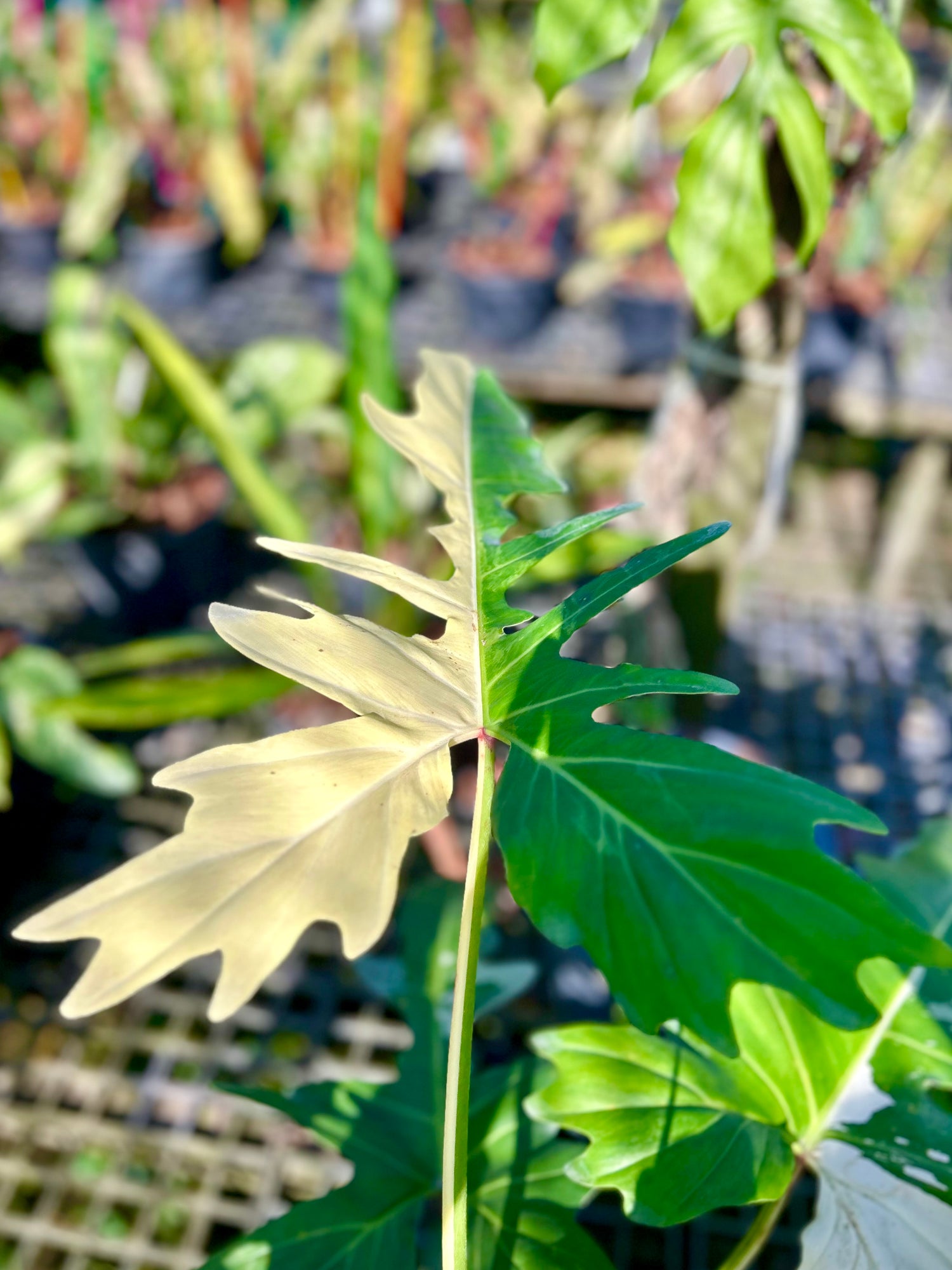


Alocasia nebula variegata rare tropical plant care
Alocasia nebula
Borneo mist, phantom variegation, and the holy grail for collectors of rare Alocasias
Introduction
There are rare tropical plants that immediately catch the eye. And then there are those that captivate you more slowly, like a subtle fragrance that lingers. Alocasia nebula is one of these plants. It doesn't shout. It whispers. Its foliage seems covered in a kind of veil, a soft, almost smoky white variegation that changes depending on the angle and the light. And it is precisely this elusive quality that sparks the obsession.
We discovered it long after we started. At that point, we already thought we “knew how to manage” Alocasias. Then 'nebula' arrived and reminded us of a simple truth.
Rare plants do not forgive shortcuts. Today, cultivated in a controlled environment , it offers us what it has promised from the beginning.
A calm, technical, and frankly addictive beauty.
Original description and botanical publication
Alocasia nebula was described as a new species by Alistair Hay, with a seminal publication in Curtis' Botanical Magazine in 2000. The Latin diagnosis places it close to Alocasia scabriuscula , while highlighting the characteristics that differentiate it.
• smaller stature
• bullate limb
• variegation
• posterior lobes with slightly wavy edges
• numerous and closely spaced primary veins
The type comes from a plant cultivated at the Royal Botanic Gardens in Sydney, dated April 30, 1999. Before its formal description, it was already circulating under horticultural names, notably Alocasia guttata var. imperialis in trade, which long maintained the confusion.
Horticultural synonyms and confusions
Alocasia nebula has been sold under a very common horticultural synonym
• Alocasia guttata var. imperialis
This point is crucial for collectors in France and Europe, as many sellers still use these old names, sometimes to artificially create several “versions” of the same plant.
Key points to remember
• There are no recognized cultivars for this species
• The names nebula Elaine or nebula Imperialis are commercial and do not correspond to botanical reality.
In our experience, this is exactly the kind of situation that creates disappointment among plant addicts.
You think you're buying a different rarity, you're simply receiving the same species under a different name.
Distribution and supposed origin
Alocasia nebula is associated with Borneo, most likely Sarawak. Its exact origin, however, remains unclear, and this is part of its mystique.
It is believed to be linked to limestone areas around Semenggoh, near Kuching, where several botanists and specialists observed it in the 1990s. Yet, despite these observations, it is still considered unknown in the wild in the strict sense, as it has not been confirmed by exhaustive modern collections.
This "misty" origin is literally inscribed in its name.
Original climate and thermal requirements
Alocasia nebula is described as a lowland tropical plant, with a need for regular warmth.
Reference climate parameters
• Humidity around 60 to 70 percent
• Temperatures can vary, but the plant requires warmth during cultivation.
• Strong wet season and drier season
In practice, in Europe, the most common mistake is keeping it too cool, especially in winter. This species does not tolerate cool roots well, and that is often where the problems begin.
Ecology and affinity for limestone
The presumed ecology of Alocasia nebula places it on humid forest soils, above limestone, at low altitudes. This affinity for limestone is an extremely important detail for its cultivation.
It took us a while to understand this point. In the beginning, we used substrates that were too acidic and too compact. Today, we know that limestone species react very well to a more mineral, more aerated structure, and to the addition of coarse dolomite.
This approach literally changes the plant's stability.
Botanical description of the species
Alocasia nebula is a small, compact Alocasia measuring 20 to 30 centimeters.
Vegetative characteristics
• Stem approximately 2.5 centimeters in diameter
• Approximately six grouped leaves
• Pale green petiole marked with purple spots and slightly raised glands
• Oval-sagittate blade, leathery but relatively thin, with blisters between the veins
• Matte grey-green top surface, dark red-purple bottom surface
The primary veins are numerous relative to the size of the leaf, often grouped and very tightly packed in the proximal part. This detail is a major identification criterion.
White variegation and hazy aesthetic
Alocasia nebula variegata is one of the main reasons for its popularity among European collectors.
Variety is generally
• White to cream
• Diffuse
• Like a veil
• Very sensitive to light
In too much light, it can turn white and lose its contrast. In too little light, growth slows and the plant can become stressed. It's a plant of balance, and that's also what makes it so appealing.
Essential botanical notes for collectors
Several points emerge from the botanical and horticultural observations.
Key points to remember
• Adults can suddenly collapse if the roots become too cold and waterlogged.
• The plant often produces corms on thin stolons
• These cormels can enter a long dormancy, but they help to secure the lineage
• Calcicolous species respond well to coarse dolomite rather than powder
Through extensive testing, we discovered that the best way to keep Nebula stable in Europe is to avoid the fatal combination.
cold, plus water, plus compacted substrate.
Culture in France and Europe
Alocasia nebula grows very well in France and Europe, but it requires precision.
Ideal conditions
• Temperature between 22 and 28 degrees during the growth phase
• Bright, indirect light, never direct sunlight
• Stable humidity between 60 and 75 percent
• Gentle and constant ventilation
• Water regularly, but only when the substrate is dry.
In apartments, we tended to water "out of fear of running out." Today, in greenhouses, we water "by reading the substrate." This nuance changes everything.
Suitable substrate and root respiration
The substrate for rare tropical plants is the key to successfully growing Alocasia nebula .
A good substrate should
• Be extremely well ventilated
• Drain quickly
• Remain slightly moist without stagnation
• Provide good root depth
Our premium substrates, cleaned three times, have already saved dozens of plant enthusiasts who were finally looking for a substrate truly suited to rare tropical plants . On nebula, the impact is particularly noticeable on leaf stability and recovery after stress.
Horticultural hybrids and genetic heritage
Alocasia nebula has already given rise to a notable hybrid
• Alocasia Simba Blue from sinuata x nebula
This type of crossbreeding is very interesting, because nebula often transmits
• compactness
• the fine ribbing
• a textured aesthetic
This makes it a valuable genetic base for modern hybrids.
Botanical and horticultural summary
| Element | Detail |
|---|---|
| Name | Alocasia nebula |
| Status | Botanical species |
| Origin | Borneo, Sarawak (probable) |
| Special feature | Bubbled leaf blade and soft variegation |
| Risk | Collapse if roots are cold and waterlogged |
| Level | Passionate collector |
In short
Alocasia nebula is a rare plant in the truest sense. Its uncertain origin, its blistered foliage, its hazy white variegation, and its sensitivity to root management make it a deeply addictive species. For collectors in France and Europe, it is both a challenge and a reward, a plant that teaches you to cultivate with care rather than rote.
Need personalized support
You can contact Green and White Plants via Instagram
https://www.instagram.com/greenandwhite_plants
We are available 7 days a week to help you and answer your questions.
You can also suggest your blog topic ideas to us; we will write them for you and for the entire community.
Looking to expand your collection of rare tropical plants?
• Pre-orders
https://greenandwhiteplants.com/collections/precommande
• Stock in France, 24-hour delivery
https://greenandwhiteplants.com/collections/plantes-rares
Need for a substrate truly suited to tropical plants
• Premium substrates cleaned three times
https://greenandwhiteplants.com/collections/substrats
👉 Join us on Instagram: greenandwhite_plants 🌿✨