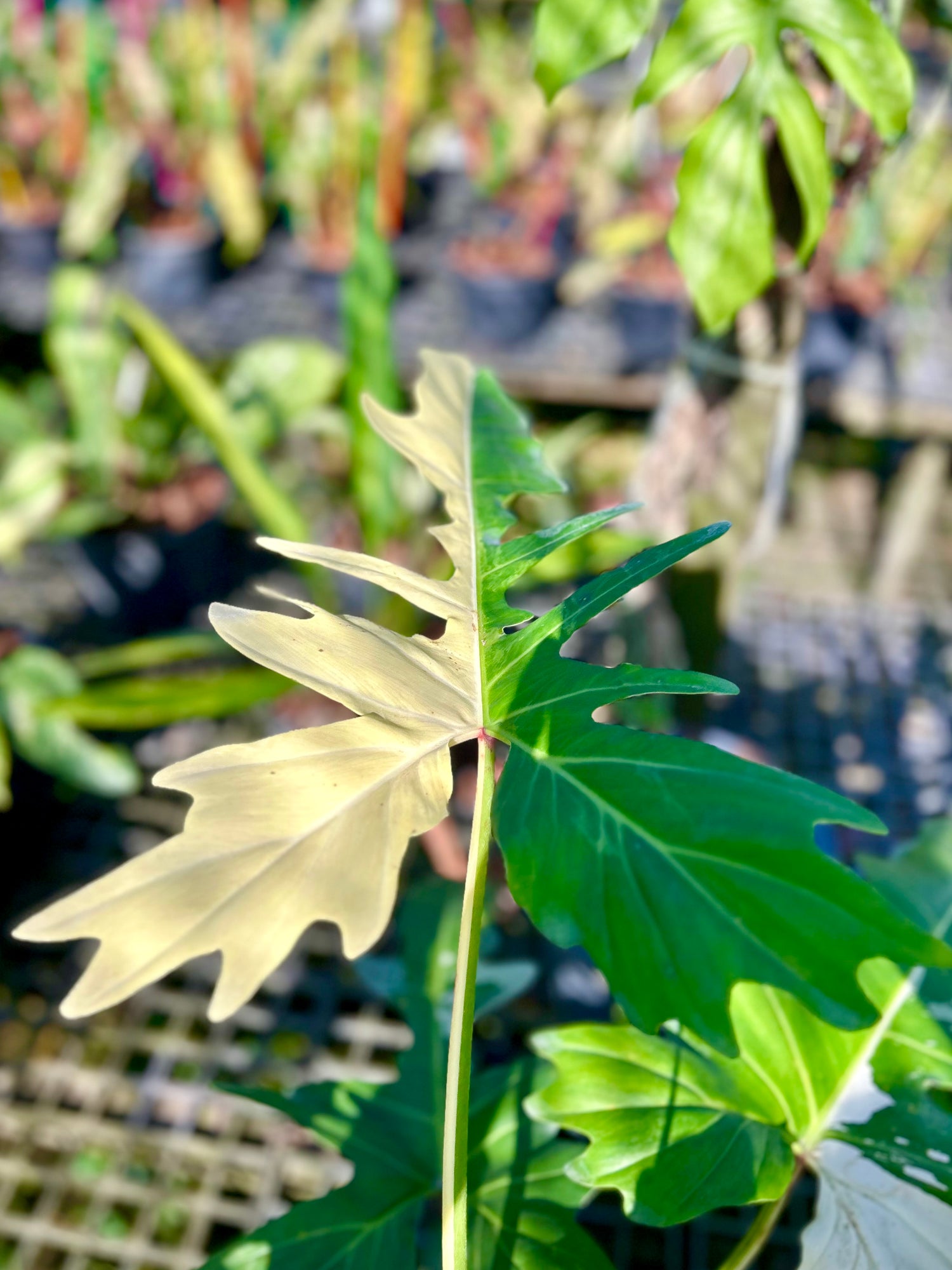


Alocasia Dragon Scale rare tropical plant cultivation Europe
Alocasia baginda 'Dragon Scale'
Dragon scales, mineral depth, and the absolute obsession of rare Alocasia collectors
Introduction
There are rare tropical plants that catch the eye. And then there are those that capture the gaze.
Alocasia baginda 'Dragon Scale' clearly belongs to this second category. The first time you see a real, well-cultivated specimen, you feel something very specific: a mixture of fascination and respect. The leaf doesn't shine. It doesn't try to seduce with color. It imposes a texture , a visual density, almost mineral.
At Green and White Plants, this plant marks a turning point. Today, cultivated in a controlled environment , it has become one of our benchmarks when we talk about the controlled cultivation of rare tropical plants in France and Europe .
Origin of the cultivar and link with the species Alocasia baginda
Alocasia baginda 'Dragon Scale' is a cultivar derived from the Alocasia baginda species, native to Borneo. Unlike some purely horticultural selections, Dragon Scale retains the strong morphological DNA of the type species, while pushing certain traits to their maximum.
The most visible difference is on the upper surface of the sheet
• a uniform deep green color
• an even more pronounced texture
• a strong contrast with the veins
Whereas the Alocasia Baginda type may display softer tones, sometimes slightly silvery, the Dragon Scale assumes a dense, almost dark green, which reinforces its reptilian appearance.
For collectors of rare tropical plants in Europe , it is often the gateway to the Baginda universe.
Morphological description and visual signature
The name Dragon Scale is not a marketing ploy. It very accurately describes what we observe.
Main features
• Thick, leathery leaves
• Highly textured adaxial surface
• Deeply embedded ribs
• Relief resembling overlapping scales
• Oval to cordate blade
• Underside lighter, sometimes slightly bluish
The leaf gives the impression of having been sculpted. It's not a plant you look at from afar. You approach it. You examine it closely. And often, you have this strange reflex
We want to touch it.
It is one of the rare tropical plants whose texture becomes the primary criterion of desire.
Why Dragon Scale triggers an obsession among plant addicts
There is a recurring phenomenon that we observe among enthusiasts
The Dragon Scale never gets old.
For what
Because its appeal doesn't lie in a temporary visual effect. It lies in the material itself . And the material ages well.
For a plant addict
• Each new leaf is an event
• Each variation in the landscape tells a story about the culture
• Every detail reflects the root condition
This plant speaks to you. If it's well cultivated, it becomes almost arrogantly beautiful. If something is wrong, it will show you that too, without beating around the bush.
Variegated forms, rarity and the European market
There is a variegated form
• Alocasia baginda 'Dragon Scale' yellow variegata
These forms remain rare , unstable, and highly sought after on the market for rare tropical plants in France and Europe . The yellow variegation, when well distributed, creates a striking contrast with the scaly texture.
However, as is often the case with highly textured plants, variegation increases sensitivity
• slower growth
• need for better-balanced lighting
• Increased attention to the substrate
These are clearly plants for knowledgeable enthusiasts.
Notable hybrids from the Dragon Scale
Alocasia baginda 'Dragon Scale' is a highly sought-after parent in hybridization, particularly for transmitting
• its texture
• its compactness
• its dark and mineral appearance
Known hybrids
• Alocasia 'Andromeda'
• Alocasia azlanii x Alocasia baginda 'Dragon Scale'
• Alocasia 'Green Dragon'
• Alocasia azlanii x Alocasia baginda 'Dragon Scale'
These hybrids often combine metallic reflections and pronounced relief, which explains their growing popularity among European collectors.
Original climate and its implications for agriculture
Like all baginda, the Dragon Scale originates from humid, warm and relatively stable tropical environments.
Natural parameters to keep in mind
• constant heat
• Actual but not stagnant humidity
• well-drained soils
• filtered light
In Europe, the classic pitfall is to underestimate the impact of cold roots . The plant may appear robust on the surface, but it hates sudden changes in the substrate.
Culture in France and Europe: What you really need to understand
Good news
Alocasia baginda 'Dragon Scale' grows very well in France and Europe, provided that a few simple but fundamental rules are respected.
Ideal conditions
• Temperature between 22 and 28 degrees
• Bright indirect light
• Humidity around 60 to 75 percent
• Gentle ventilation
• No cold drafts
Many losses occur in the fall. Not because the plant is fragile, but because humidity remains high while the temperature drops. That's exactly what we were doing at the beginning. Today, we know that stability is the key.
Substrate, roots and texture, the invisible link
The substrate for rare tropical plants is absolutely central to the Dragon Scale. It directly determines the final texture of the leaves.
A suitable substrate must
• drain quickly
• remain slightly damp
• to provide strong oxygenation
• never settle
A substrate that is too compact gives
• soft leaves
• less pronounced texture
• irregular growth
That's precisely why our premium substrates, cleaned three times, have already saved over 50 plant addicts and satisfied more than 100 enthusiasts who were looking for a substrate truly suited to rare tropical plants . On Dragon Scale, the difference is visible from the second or third leaf.
Daily maintenance and growth rate
Dragon Scale is not a fast plant. And that's a good thing.
What you can expect
• moderate growth
• thick and durable leaves
• steady pace if conditions are good
Maintenance tips
• controlled watering
• Light but regular fertilization during warm periods
• Gentle cleaning of the leaves
• Monitoring for common Alocasia parasites
It's a plant that teaches you patience. And often, the plant enthusiasts who appreciate it are those who have already experienced some setbacks.
Table summary
| Element | Detail |
|---|---|
| Name | Alocasia baginda 'Dragon Scale' |
| Kind | Cultivar |
| Origin | Borneo |
| Special feature | Pronounced scaly texture |
| Variety | YELLOW |
| Level | Passionate collector |
| European Culture | Excellent if the substrate is suitable |
In short
Alocasia baginda 'Dragon Scale' is a modern icon among rare tropical plants . It doesn't seek to shine; it asserts its presence through substance, texture, and density. In France and Europe, it becomes a stable and deeply rewarding plant as soon as three key principles are respected.
Constant heat, soft light and perfectly aerated substrate.
Need personalized support
You can contact Green and White Plants via Instagram
https://www.instagram.com/greenandwhite_plants
We are available 7 days a week to help and answer your questions.
You can also suggest your blog topic ideas to us; we will write them for you and for the entire community.
We also offer the Alocasia Baginda Dragon Scale Albo Variegata:
Looking to expand your collection of rare tropical plants?
• Pre-orders
https://greenandwhiteplants.com/collections/precommande
• Stock in France, 24-hour delivery
https://greenandwhiteplants.com/collections/plantes-rares
Need for a substrate truly suited to tropical plants
• Premium substrates cleaned three times
https://greenandwhiteplants.com/collections/substrats
👉 Join us on Instagram: greenandwhite_plants 🌿✨