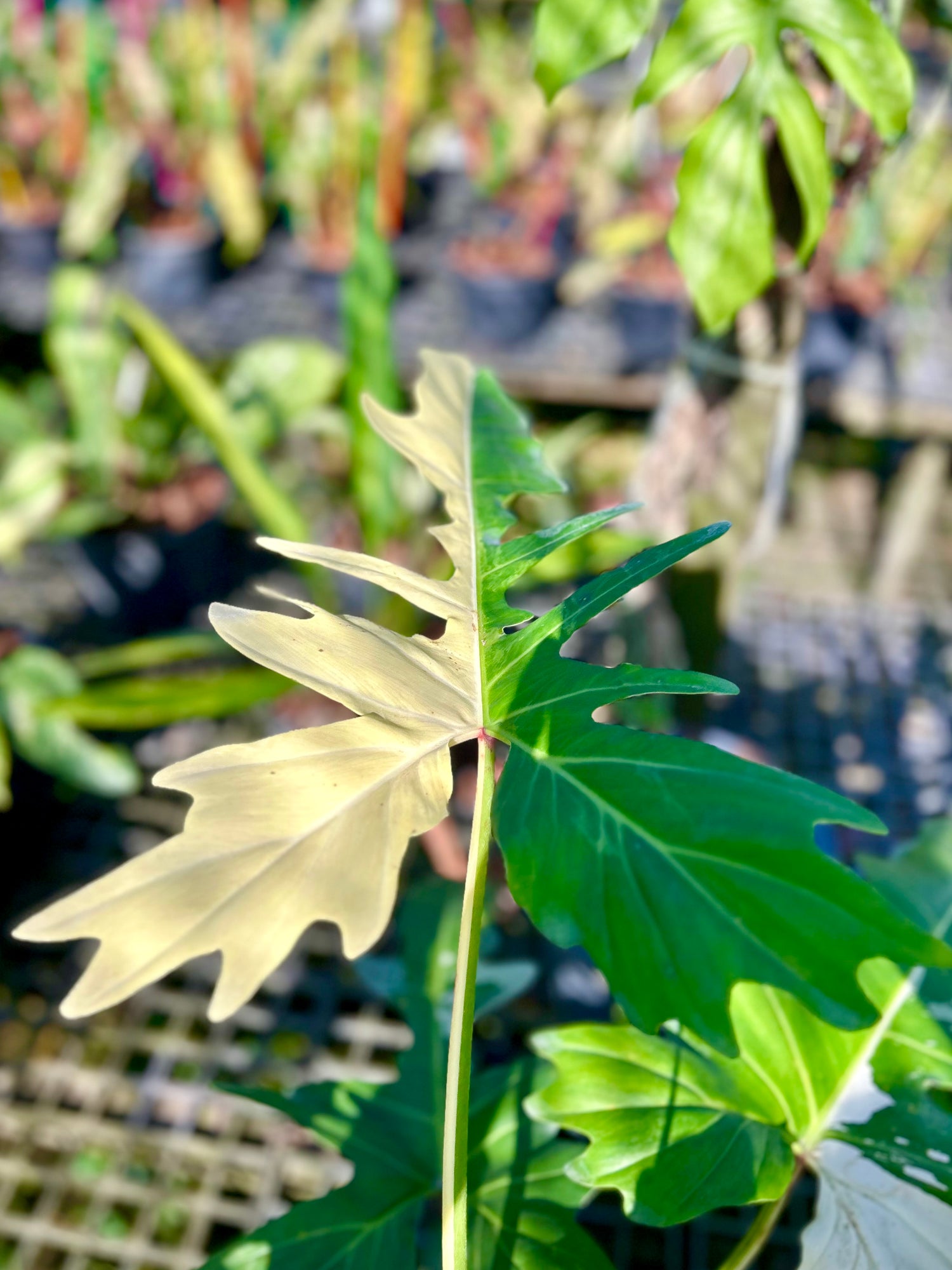


Alocasia cucullata care, a rare tropical plant from France and Europe
Alocasia cucullata
Alocasia, an ancient and virtually indestructible plant associated with temples, is a source of good luck for beginners and a delight for collectors.
Introduction
There are plant-addict moments you're bound to recognize. You love rare tropical plants , but sometimes you just want a plant that watches you grow, that's there for you, that lets you breathe. A plant that doesn't punish you for every beginner's mistake with a melting leaf or an existential crisis over an overly wet pot.
And then one day, you stumble upon the Alocasia cucullata . It doesn't need to be the most variegated or the rarest to be charming. It has something else. A gentle presence. An almost protective leaf shape, like a small hood, and a history that makes it strangely… reassuring.
At Green and White Plants, we first encountered this species back when we spent our lives fine-tuning the lighting and then trying to understand the true differences between ambient and stagnant humidity. We thought all Alocasias were temperamental. Then we realized that some were simply misunderstood. Today, cultivated in a controlled environment , Alocasia cucullata has become a simple yet invaluable reference for us. It's one of those plants that rekindles people's appreciation for the Alocasia genus, while offering a genuine botanical dimension to enthusiasts.
One of the oldest known Alocasia species
Alocasia cucullata is one of the oldest known species in botany. It was published as early as 1790 in Flora cochinchinensis , at a time when the genus Alocasia did not even exist yet. It was initially described under the genus Arum , which already tells us a great deal about its antiquity in botanical history.
This crossing of genera is a classic feature of the Araceae family, and Alocasia cucullata is a perfect example. It's not a new phenomenon that appeared yesterday on Instagram. It's a species that has spanned centuries, regions, and uses.
Botanical synonyms and names you might encounter
Alocasia cucullata has been sold under many names. For enthusiasts of rare tropical plants in France and Europe , this is important because it explains some of the confusion, price differences, and sometimes misleading advertisements.
Homotypic synonyms ( Characterizes what is identical in shape*)
• Arum cucullatum
• Caladium cucullatum
• Colocasia cucullata
Heterotypical synonyms ( Designates or qualifies a species that differs from the accepted form for the type species , that deviates from the representative form generally observed for a given population*)
• Alocasia rugosa
• Caladium colocasia
• Caladium rugosum
• Colocasia cochleata
• Colocasia rugosa
• Panzhuyuia omeiensis
Other names encountered
• 尖尾芋 in Chinese, often translated as “Cuspidate Alocasia”
• Alocasia 'Buddha's Palm' , a name that reflects its cultural and spiritual use in Southeast Asia
We often say this at Green and White Plants.
A plant that has many names often has many stories.
Natural distribution and global diffusion
Alocasia cucullata has an extremely wide natural distribution, which explains its relative robustness and adaptability.
Natural presence
• Assam
• Bangladesh
• Central, southern and southeastern China
• Eastern and Western Himalayas
• Hainan
• Laos
• Myanmar
• Sri Lanka
• Taiwan
• Thailand
• Vietnam
And it has also been introduced to several regions of the world, which confirms its ability to be cultivated in varied contexts.
Introduced in particular
• Japan
• Cook Islands
• Central America
• Several Pacific archipelagos
For culture in Europe, this geographical breadth is a valuable indicator
It is a more tolerant species than many Alocasias.
Original climate and ecology
Alocasia cucullata comes from a humid subtropical climate , with parameters quite close to what can be recreated indoors in France if one understands the priorities.
Key parameters
• Humidity around 60 to 70 percent
• Temperature from 9 to 31 degrees
• Minimum never below 7 degrees
• Wet season from October to May
• Drier season from June to October
• Rainfall around 1200 mm
Its natural ecology speaks volumes.
• waterfronts
• fields
• wild or cultivated areas
• altitude below 2000 m
It's not just a deep forest plant. It's sensitive to light, transitions, and variations. This explains its reputation as an easier plant to grow.
Botanical description and plant habit
Alocasia cucullata is a herbaceous plant, which grows in clumps, small to medium in size, but can reach about one meter.
Vegetative characteristics
• clump-like growth
• erect, underground stems, branched at the base
• numerous leaves grouped together
• petiole of 25 to 30 cm, which can grow longer under ideal conditions
• blade broadly oval and cordate
• slightly heart-shaped base
• acute apex
• four main ribs on each side
A lovely and very useful point
It's one of the few Alocasias that branches naturally , often after a flowering phase. And for a plant enthusiast, it's a very special feeling. You're no longer looking at a plant, you're looking at a plant that multiplies.
A plant brings good luck, and that's not just a legend.
Alocasia cucullata is a lucky plant widely used in Buddhist temples in Laos and Thailand. It is often placed at the entrance or near altars. It symbolizes protection and good fortune.
And what's beautiful is that this is reflected in its shape. The "cap" leaf has something protective about it. Even if you don't believe in symbols, you can feel a benevolent plant energy.
It also has traditional uses, notably for external application in some regions, and sometimes even the consumption of its rhizomes in certain areas of India. This remains an important cultural element, but in European indoor cultivation, it is primarily valued for its beauty and hardiness.
Culture in France and Europe: accessible but not neglected
Alocasia cucullata has a reputation for being an easy plant, and it deserves it, but be careful
Easy does not mean indestructible.
Ideal conditions
• Temperature between 20 and 28 degrees
• Bright indirect light
• Stable humidity around 60 percent
• Water regularly, but not excessively
• Gentle ventilation
The classic mistake beginners make is overwatering because the plant "looks okay." It resists, then one day it breaks. In reality, it gives you some leeway, but it still needs a healthy base.
Substrate, roots and growth: the key that changes everything
Although more tolerant, Alocasia cucullata loves a well-designed substrate for rare tropical plants .
An ideal substrate should
• be ventilated
• drain quickly
• maintain a slight humidity
• never compact
That's exactly why our triple-cleaned premium substrates have already saved several plant addicts and satisfied hundreds of enthusiasts who were looking for a substrate truly suited to rare tropical plants .
And on a Cucullata, you can see it quickly: firmer leaves, more regular growth.
Known cultivars and collection ideas
Alocasia cucullata has given rise to several cultivars, making it a perfect basis for creating a coherent collection.
Existing cultivars ( A variety of a plant species obtained artificially for cultivation.*)
• Alocasia cucullata 'Banana Split'
• Alocasia cucullata 'Crinkles'
• Alocasia cucullata 'Moon Landing'
• Alocasia cucullata 'White Lace'
• Alocasia cucullata 'Yellow Tail'
Some forms exhibit variegation aurea , mint or albo , which adds a rare dimension to an already highly valued plant.
Table summary
| Element | Detail |
|---|---|
| Name | Alocasia cucullata |
| Botanical antiquity | Published as early as 1790 |
| Nickname | Buddha's Palm , a lucky plant |
| Origin | South and Southeast Asia |
| Level | From beginner to enthusiast |
| Special feature | Branch naturally |
| Variety | YELLOW |
| European Culture | Very good if the substrate is suitable |
In short
Alocasia cucullata is an ancient species, steeped in history and surprisingly accessible. It reassures beginners, yet retains a true botanical depth for enthusiasts. In France and Europe, it becomes a stable and rewarding plant as soon as you adhere to three key principles.
warmth, soft light and aerated substrate.
Need personalized support
We currently have sections of Alocasia Cuculatta "Wagyu" Albo Variegata in our catalogue:
https://greenandwhiteplants.com/products/alocasia-cuculatta-wagyu-albo-variegata-troncon-1-feuille
You can contact Green and White Plants via Instagram
https://www.instagram.com/greenandwhite_plants
We are available 7 days a week to help and answer your questions.
You can also suggest your blog topic ideas to us, we will write them for you and for the whole community.
Looking to expand your collection of rare tropical plants?
• Pre-orders
https://greenandwhiteplants.com/collections/precommande
• Stock in France, 24-hour delivery
https://greenandwhiteplants.com/collections/plantes-rares
Need for a substrate truly suited to tropical plants
• Premium substrates cleaned three times
https://greenandwhiteplants.com/collections/substrats
👉 Join us on Instagram: greenandwhite_plants 🌿✨