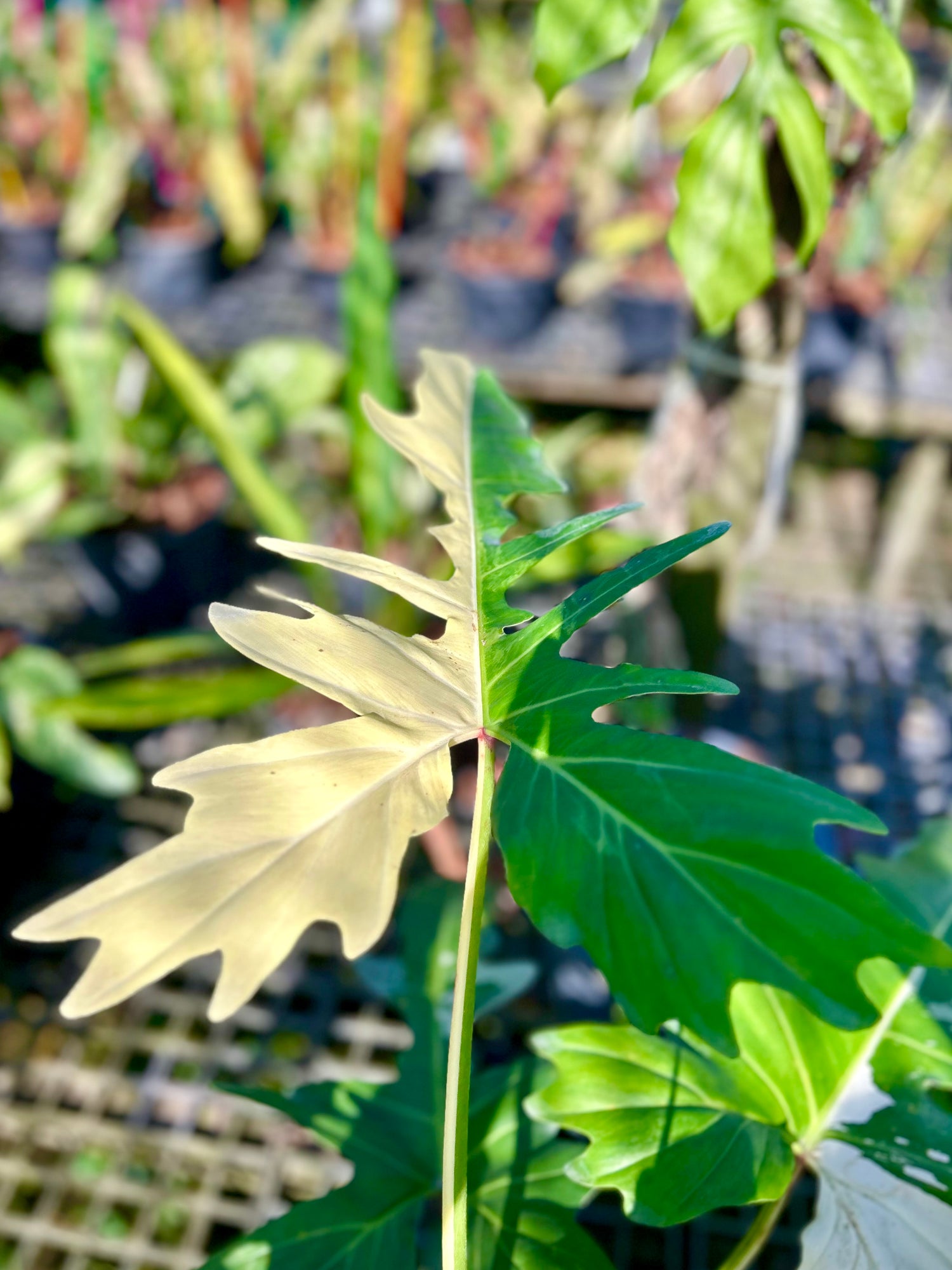


Alocasia brancifolia rare tropical plant cultivation Europe
Alocasia brancifolia
Deeply lobed foliage, wild elegance, and botanical Alocasia for discerning enthusiasts
Introduction
There are rare tropical plants that impress with their size. Others with their colors. And then there are those that fascinate with their shape , with the almost animalistic impression they give off.
Alocasia brancifolia is one of those plants that doesn't immediately capture your understanding. You look at it, you get closer, you examine each segment of its leaf… and suddenly it dawns on you. This foliage isn't decorative in the traditional sense. It's wild , graphic, almost aggressive. A leaf like an open paw, ready to seize the light.
Botanical origin and complex taxonomic history
The botanical history of Alocasia brancifolia is rich and reveals the complexity of the Araceae family.
It was first described in 1863 under the genus Xenophya , in the Annals of the Lugduno Batavi Botanical Museum of the University of Utrecht. At that time, the understanding of Araceae genera was still fragmentary, and many species moved between different classifications.
In 1898 , it was reclassified in the genus Alocasia under the name Alocasia acuta . It was only in 1990 , thanks to the work of Alistair Hay in Aroids of Papua New Guinea , that it definitively acquired its accepted name.
Alocasia brancifolia .
This long taxonomic journey is typical of rare tropical botanical plants , which were observed in cultivation for a long time before being fully understood.
Botanical synonyms and common confusions
Alocasia brancifolia has accumulated many synonyms, which explains the confusion still frequent on the European market.
homotypic synonym
• Xenophya brancaefolia
Heterotypical synonyms
• Alocasia acuta
• Alocasia acuta var. angustipartita
• Alocasia acuta var. tigrina
• Arum fasciculatum
• Schizocasia acuta
• Schizocasia acuta var. angustipartita
• Schizocasia acuta var. tigrina
For collectors of rare tropical plants in France and Europe , this point is crucial. Many plants sold under the name Alocasia acuta are actually Alocasia brancifolia .
Natural distribution and geographical area
Alocasia brancifolia is native
• of New Guinea
• the Maluku Islands
• from eastern Indonesia
• of Papua New Guinea
This geographical range explains its adaptation to very humid, hot, and sometimes swampy environments. It is a lowland tropical forest plant, not a cool mountain plant.
Original climate and environmental parameters
The original climate is a hot and humid tropical climate , classified as Af.
Key parameters
• High humidity between 70 and 90 percent
• Daily temperatures between 23 and 32 degrees
• Minimum temperature never below 18 degrees
• Significant rainfall, sometimes with a short drier season
This point is crucial. Alocasia brancifolia does not like cold , even relative cold. In Europe, it must be protected from temperature drops, especially at the root level.
Natural ecology and habitat
In its natural environment, Alocasia brancifolia grows
• in the undergrowth of lowland tropical forests
• in areas that are sometimes marshy
• occasionally in more open areas after clearings
This explains two things we've learned through experience.
• She likes real humidity
• but it hates a suffocating potting mix
In nature, water circulates. In a pot, if the substrate is poorly chosen, it stagnates.
Detailed botanical description
Alocasia brancifolia is an impressive, yet elegant plant.
General characteristics
• Upright brownish stem up to 1.2 meters
• Trunk diameter can reach 7 cm
• Approximately 6 leaves grouped in a crown
The petiole
• up to 40 cm
• green with heavy chocolate brown stripes
• persistent sheath over one-third to one-half
The leaf blade is the signature of the species
• Sagittate shape
• lobes deeply pinnatifid (a simple leaf that is symmetrically divided on each side of the midrib, reaching half the width of the blade*), sometimes up to a few millimeters from the midrib
• anterior lobe up to 50 cm long
• narrow, lanceolate segments
• reduced but deeply lobed posterior lobes
The venation is very graphic, almost architectural, giving the plant a spectacular presence among rare tropical plants .
Etymology and meaning of the name
The name brancifolia comes from Latin
• branca meaning paw or claw
• folia meaning leaf
It's a perfectly chosen etymology. The leaf clearly evokes an open, almost animalistic paw. It's an Alocasia that can be recognized from a distance, even without seeing the entire plant.
Natural variability and identification errors
Alocasia brancifolia is variable
• segment width
• intensity of the zebra stripes
• cutting depth
These variations exist within the same population . They are interesting from a horticultural perspective, but do not justify an official botanical distinction.
Culture in France and Europe, for discerning enthusiasts
Alocasia brancifolia is cultivated in Europe, but it is not a plant for a forgotten shelf.
Ideal conditions
• Stable temperature between 24 and 30 degrees
• High humidity but well-ventilated
• Bright indirect light
• No cold drafts
• Maximum stability
We have seen many failures related to nighttime temperature drops. In a controlled environment, it reveals its full potential.
Substrate and root management
The substrate for rare tropical plants is absolutely crucial.
He must
• drain very quickly
• remain moist without being saturated
• offer plenty of air
• never compact
It is precisely for this type of demanding species that our premium substrates, cleaned three times , exist; they have already saved dozens of plant addicts and satisfied hundreds of enthusiasts in search of a substrate truly suited to rare tropical plants .
Horticultural market
There are currently no nurseries in Europe that offer it, but this will change from next January, we will include it in our catalogue.
Table summary
| Element | Detail |
|---|---|
| Name | Alocasia brancifolia |
| Origin | New Guinea, Maluku |
| Special feature | Deeply cut leaves |
| Climate | Hot and humid tropics |
| Level | Knowledgeable enthusiast |
| Variety | None known |
| European Culture | Possible under controlled conditions |
In short
Alocasia brancifolia is a spectacular, wild, and striking botanical Alocasia. It appeals to plant enthusiasts who love understanding their plants as much as admiring them. In France and Europe, it becomes stable and majestic as soon as three key principles are respected.
constant heat, real humidity and perfectly aerated substrate.
Need personalized support
You can contact Green and White Plants via Instagram
https://www.instagram.com/greenandwhite_plants
We are available 7 days a week to help you and answer your questions.
You can also suggest your blog topic ideas to us; we will write them for you and for the entire community.
Looking to expand your collection of rare tropical plants?
• Pre-orders
https://greenandwhiteplants.com/collections/precommande
• Stock in France, 24-hour delivery
https://greenandwhiteplants.com/collections/plantes-rares
Need for a substrate truly suited to tropical plants
• Premium substrates cleaned three times
https://greenandwhiteplants.com/collections/substrats
👉 Join us on Instagram: greenandwhite_plants 🌿✨